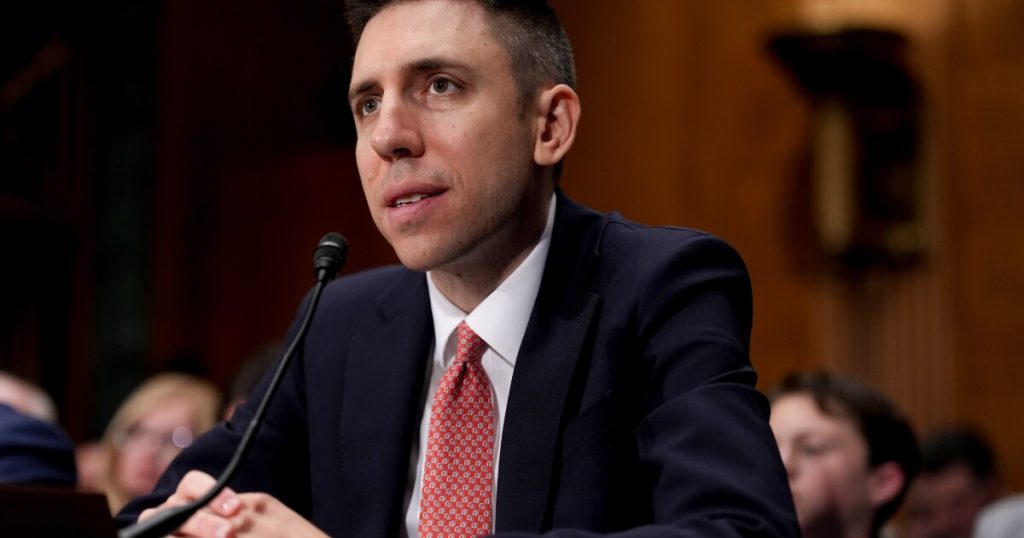
- Key insight: Under Chair Travis Hill, the FDIC has undergone a sweeping deregulatory and institutional reset, rolling back Biden-era rules, accelerating mergers and charters, embracing fintech and crypto activity, and shrinking its own footprint.
- Supporting data: The agency cut 1,300+ staff this year, revoked job offers made to bank examiners and will apparently continue to operate with two vacant minority-party board seats.
- Forward look: In 2026, the FDIC will likely confront a Supreme Court ruling that further weakens independent regulators’ removal protections, deepening the White House’s direct control over the agency.
Upon taking the reins of the Federal Deposit Insurance Corp. in January, then-acting Chair Travis Hill laid out his near-term ambitions for the agency, which included rescinding several rules and guidance documents issued during the Biden administration and resetting the agency’s approach to digital assets, mergers and bank resolution.
Processing Content
Nearly a year later, the agency has made good on several of those promises, and Hill himself has been confirmed as the permanent head of the agency. But the agency itself remains in transition, with more than 1,300 agency personnel having departed since this time last year and the cloud of a workplace culture scandal continuing to hang over the agency.
‘Right-sizing’ regulation
As vice chair of the FDIC, Travis Hill was slated to take over for former FDIC Chair Martin Gruenberg upon Gruenberg’s resignation on inauguration day 2025. Hill — who was appointed as vice chair by President Biden and had previously served as a senior advisor to former FDIC Chair Jelena McWilliams — has led the FDIC with a focus on what he calls “right-sizing” regulation. Trump ultimately nominated Hill as permanent FDIC chair in October, and he was confirmed by the full Senate earlier this month.
HIll’s deregulatory focus mirrors the tone set by Treasury Secretary Scott Bessent — the administration’s most influential financial policy voice — who made the case for a unified deregulatory front in a March speech at the Economic Club in New York. Bessent said he was coordinating regulatory actions across the banking agencies like FDIC to ensure they are “singing in unison from the same song sheet.”
Bessent said bank regulatory agencies need to turn the page on Dodd-Frank Act regulations implemented after the financial crisis. Under his stewardship, the FDIC has unwound and pared back dozens of bank regulations — many crafted in the wake of the 2008 financial crisis — that are seen as onerous and, in Bessent’s view, partially responsible for banks’ decreasing market share in financial activities traditionally handled by banks.
Early on, Hill ordered a sweeping review of regulations to ensure they promote economic growth. Shortly after he took the helm, the FDIC withdrew from an international body devoted to combating climate-driven financial risks, following the Federal Reserve’s decision to do so days prior.
Hill also singled out the FDIC’s Biden-era Statement of Policy on bank mergers as a policy worthy of rescission. Hill withdrew the statement in May, reverting the agency’s guidance to its prior stance and promising new guidance that would expedite approvals without sacrificing the rigor of agency reviews.
Hill also said he expects the agency to repeal what he called “problematic” proposals on brokered deposits and corporate governance — two FDIC measures he has publicly opposed. Consumer protections enacted under the previous administration were also targeted for rescission, including the Community Reinvestment Act rules finalized under the Biden administration.
In April, Hill — speaking at the American Bankers Association’s Washington Summit — said the Biden administration took the “wrong lessons” from the 2023 regional bank crisis. In response, the agency revised its so-called insured depository institution, or “IDI,” rule — issued in June 2024 — which sought to eliminate hurdles the agency faced in winding down failing banks during the 2023 crisis, but that Hill said was unworkable. The new standards allow flexibility and prioritize speed of resolution, potentially foregoing the “least cost” resolution if necessary.
Hill said the FDIC will also work with larger banks to improve their ability to acquire failed institutions if needed. By enabling these banks to bid quickly on or purchase parts of failed firms, Hill said he aims to reduce the cost and duration of bank resolutions, even by allowing private equity firms to bid for failed banks.
He has also shepherded an effort to raise the asset thresholds used to group banks for regulatory purposes — a concept known as “tailoring.”
The FDIC sent a draft proposal on the supplementary leverage ratio to the Office of Information and Regulatory Affairs as a first step toward revising the leverage rule. The proposal was finalized in November. Former FDIC Chair and Republican Sheila Bair warned the rollback, alongside other deregulatory moves, could spur a banking crisis. Senate Banking Committee ranking member Elizabeth Warren, D-Mass., also criticized the proposal.
The FDIC also rescinded a Biden-era industrial loan company rule in July, issued a proposal to index regulatory thresholds to inflation, and scrapped a leveraged lending guidance in November.
The FDIC also moved to drop “reputational risk” from its supervisory framework, finalized in October, as part of what Hill described as a refocus on material, safety-and-soundness risks, a change prompted by fallout from what critics call politically motivated debanking in previous administrations. The FDIC in late March allowed banks to engage in crypto-related activities without prior regulatory approval and proposed guidance allowing banks to issue stablecoins earlier this month.
The amazing shrinking FDIC
The backdrop of deregulation comes at a time when the agency itself is contracting, both among the rank-and-file and at the top.
In February, the FDIC was directed to identify staff positions and programs not explicitly required by law under an executive order signed by President Trump aimed at making deep cuts to the federal workforce. Under the order, agency heads were instructed to work with the Department of Government Efficiency — led by billionaire entrepreneur Elon Musk — to shrink the workforce and restrict hiring to essential roles.
Amid the Trump administration’s federal workforce downsizing push, the FDIC drew criticism from Democratic senators — led by Warren — after it revoked hundreds of job offers for bank examiners. The senators said the move contradicted prior advice from the FDIC’s inspector general to bolster staffing levels to prevent bank failures.
By late February, the FDIC had shed roughly 700 staff. An email obtained by American Banker in April showed that a team of Department of Government Efficiency employees had been working to restructure the agency and shrink its headcount.
By April, the FDIC had cut roughly 1,250 staff across most departments, prompting calls from Warren and other Democratic senators for greater transparency and raising concerns about weakening the agency’s effectiveness. Ultimately the agency cut over 1,300 staff.
Rumors of agency consolidation — an idea floated by DOGE in late 2024 during the Trump transition — also sparked debate among state banking advocates and critics of government complexity. Those ambitions ultimately petered out, with bankers split on the need for agency consolidation, according to an IntraFi survey in February.
The FDIC board has also seen a contraction. Normally, the board consists of the heads of the Consumer Financial Protection Bureau, Office of the Comptroller of the Currency, and the chair and vice chair of the FDIC, as well as one additional FDIC board member. By statute, the vice chair and board member must be members of a different political party than the majority; typically those seats are reserved for Republicans when Democrats control the White House and vice versa.
The current board consists of Hill, acting CFPB Director Russell Vought, and Comptroller of the Currency Jonathan Gould, who took over as permanent OCC chief in July. President Trump has thus far ignored the requirement that two non-Republicans serve on the board, with no evident plans to fill those vacancies going forward.
These major reforms are coming against the backdrop of heightened scrutiny of the agency’s workplace culture after a bombshell investigation revealed scores of incidents of sexual harassment and racial discrimination at the agency spanning decades. In March, the agency’s Office of Inspector General said the FDIC was grappling with attrition and unresolved workplace issues that were hindering its ability to meet its regulatory duties.
After months of complaints about the pace and seriousness of the Biden-era FDIC’s response to a pervasive culture of sexual harassment and discrimination, Hill has now assumed responsibility for addressing its workforce problems as well as control of the agency.
Though he was ultimately confirmed, Hill faced pointed scrutiny during his October confirmation hearing. At one point, Sen. John Kennedy threatened to withhold his vote after Hill, who was a senior FDIC executive during years when a toxic culture allegedly flourished, failed to present a record of intervention or evidence he was making substantial progress on implementing reforms.
Setting the stage for ‘innovation’
Hill has repeatedly emphasized his call for clearer FDIC guidance to promote innovation in financial services and prime the pump for new bank formation, something lawmakers pressed at a February hearing.
Regulators’ openness to a faster charter application process has already triggered a wave of fintech bank charter applications. While some of the most notable applications have been with the OCC for national trust charters, the FDIC has also seen an uptick in applications for industrial loan company charters.
In February, GM Financial, the Detroit automaker’s lending arm and a Utah-chartered industrial loan company resubmitted its long-stalled application for FDIC deposit insurance. The agency issued a request for information on such banks in July.
ILC hopefuls have seized on the friendlier chartering environment. PayPal applied this month, and high profile firms like Nissan and Stellantis currently have deposit insurance applications pending. While ILC approvals are now seen as more achievable, limits remain, reflecting lingering unease about mixing commerce and banking.
The shift to promoting novel and once-fringe charters has been most pronounced within the debanking debate.
The administration’s apparent indifference to filling minority party seats at the FDIC is part of a broader philosophical shift in the Trump administration away from regulatory independence in general.
Over the course of 2025, the administration has fired scores of independent regulators — all Democrats — serving fixed terms. Those fired regulators — who served on commissions like the Equal Opportunity Employment Commission, National Labor Relations Board, Federal Trade Commission and National Credit Union Administration — sued the administration for their jobs back. The Supreme Court heard oral argument in a case brought by ousted FTC Commissioner Rebecca Slaughter in December, and justices appeared sympathetic to the administration’s perspective.