- Key insight: The bank hired two executives and launched a new private banking team to diversify its loan portfolio and nab more of its clients’ business.
- What’s at stake: Despite a growth-via-acquisition strategy, Simmons has underperformed peers in the market in recent years.
- Forward look: The company’s largest opportunity to exceed its guidance for 2026 is by racking up low-cost deposits, the CEO said.
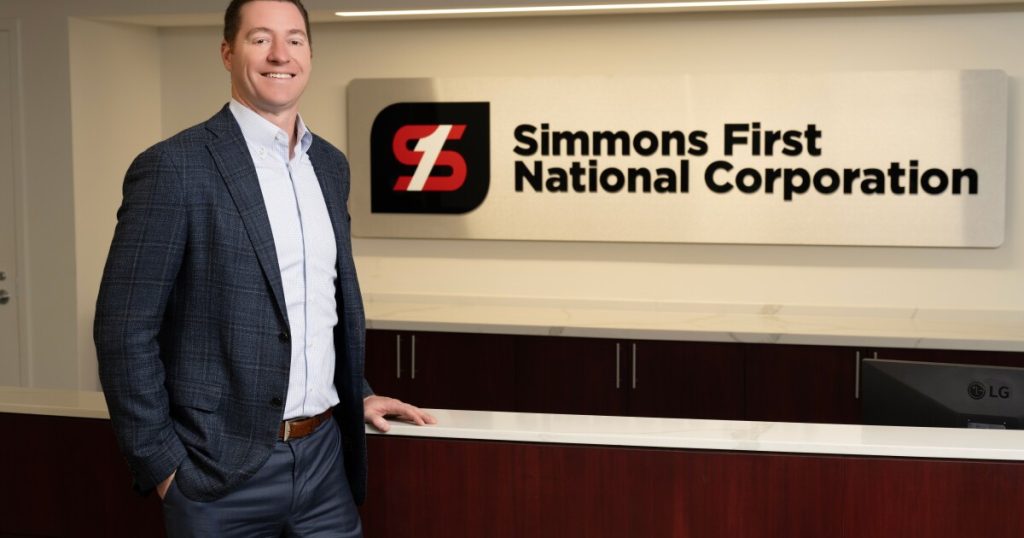
Simmons First National is bulking up its executive leadership team under its new CEO, Jay Brogdon, the bank’s latest move in its strategy to boost its deposit network and deepen relationships with its customers.
Processing Content
The Pine Bluff, Ark.-based bank announced Monday that it has hired new leaders of its consumer and wealth management division and its commercial banking business, along with an eight-person private banking team.
Brogdon, who officially took the reins on Jan. 1, said in an interview with American Banker that the company is focused on picking up top bankers throughout its six-state network to diversify its loan portfolio and nab more business from existing customers as well as new ones.
The strategy marks a shift from Simmons’ long-term blueprint. The $25 billion-asset company acquired 14 banks in under a decade, the most recent deal closing in 2022. It has been trying to boost organic growth since then, though in a competitive and at times challenging environment.
“Delivering organic growth — that’s not been our strong suit historically,” Brogdon said. “Most of our growth has been through acquisitions. But you know, you go back to late 2021 and we really shifted the priority to enabling organic growth.”
Now, the company wants to drive performance through new hires and products, instead of through deals, Brogdon said.
Specifically, Simmons is looking to widen its breadth of offerings to clients, he said. The bank’s historical bread-and-butter is commercial real estate lending, which makes up more than three-quarters of its total loan portfolio. But Simmons wants to beef up other sectors, and concurrently capture clients’ full business, such as treasury management and operating accounts.
Brogdon said that the frothy dealmaking environment among banks is a tailwind for Simmons as it looks to pick up more talent.
“Our pipelines, from a talent perspective, are stronger than they’ve been at any point, at least since I’ve been at the bank,” Brogdon said, who joined Simmons in 2021. “Most of our growth, historically, has been through acquisitions. We’re seeing really dynamic opportunities and frequent opportunities from a talent perspective.”
On Monday, the company announced it had hired Brian Jackson as president of consumer and wealth management. Jackson, who had previously led consumer products at Regions Bank, will help Simmons bring its products to the marketplace at scale, Brogdon said. Jackson will be based in Little Rock.
The bank also tapped Jonathan Schneider as president of commercial banking, to be based in Dallas. Schneider most recently ran the private equity and fund finance lending team at Veritex Bank, which was bought by Huntington Bancshares last fall.
Both of the new appointments will report to Brogdon.
Along with the executives, Simmons brought on an eight-member private banking and wealth management team based in St. Louis, which will also serve Kansas City, Oklahoma City and Wichita.
Simmons has offered wealth management services in its legacy footprint for years, but is now hoping to build out that business in regions where it’s expanded through acquisitions, Brogdon said. The private banking business, though, is still in “very early innings,” Brogdon said.
But the bank’s strategy to boost its private banking unit, capture more business from customers and diversify its loan portfolio isn’t unique. Banks across the country have made similar efforts to combat similar economic pain points.
The rapid rise of interest rates in 2022 and 2023 put pressure on commercial real estate loans at banks across the country. Then, when a series of banks failed in 2023, competition for stable deposits stiffened. Policy and economic uncertainty in the past few years has put further strain on loan growth.
During that time, Simmons’ earnings have underperformed peers. Simmons’ stock price is down nearly 11% in the last year, while the Nasdaq Regional Banking Index is up close to 5%.
The company launched what it calls its Better Bank initiative a few years ago, focused on improving efficiency through automating processes and procedures. Simmons has steadily been able to cut expenses in certain areas so it could fund organic growth.
Brogdon said the savings from the Better Bank effort are starting to pay for its investments in hiring.
“We’re starting to see that inflection,” Brogdon said. “That investment we’ve made over the last couple of years, where we can demonstrate the results on the efficiency side, are beginning to inflect. And you’re seeing us invest in the talent. And I think you’ll see us really begin to demonstrate the results on the organic growth side, as well.”
Stephen Scouten, an analyst at Piper Sandler, wrote in a note after the bank’s fourth-quarter earnings that “directional trends” at the bank were “positive and improving.”
“[Simmons] has positioned itself well for a much improved 2026 earnings profile,” he wrote. “With profitability looking to approach peer medians, loan growth returning more meaningfully, and the bank’s strong expense management painting a clearer picture around future [earnings per share] improvement.”
Piper Sandler rates the stock neutral with a $22 price target. Shares closed Friday at $20.31.