American Banker’s 2026 Predictions Report
American Banker’s 2026 Predictions report was fielded online during October and November of 2025 among 174 banking professionals who work across a variety of executive roles at banks, credit unions, neobanks and payments companies.
A closer look at midsize and regional banking leaders’ responses reveals what midsize bank leaders care about most. Top findings from the report
- Mobile apps are the top area of investment for regional bankers.
- Agentic AI is eyed by regional bankers as a major driving force of change in the banking industry for 2026.
- Close to half of regional bankers are most worried about wire transfer fraud impacting their organization in 2026.
Results from the report are highlighted below using interactive charts. Mouse over each section for more detail, click on the chart labels to show or hide sections and use the arrows to cycle between chart views.
This item focuses on results from midsize and regional bankers. To view findings broken down by respondent category, click the links below.
Processing Content
To view the overall research, click the links below.
Mobile banking apps top list of regional banking tech investments
Regional bankers are doubling down on their mobile platforms to improve their offerings and compete against challenger institutions that offer customers modern suites of financial products.
More than half of midsize and regional bank respondents (54%) listed mobile apps as a top five spending priority for 2026. This was the category that saw the greatest share of regional banking respondents.
Community banks were close behind (31%), followed by national banks (27%) and lastly credit unions (14%).
Mobile banking apps are a critical touch point for banks and credit unions alike working to onboard new customers, as the days when
Challenger banks from overseas quickly kicked off the year with efforts to establish a foothold in the U.S.
The Brazilian neobank Nubank received conditional approval from the Office of the Comptroller of the Currency to
“This approval isn’t just an expansion of our operation; it’s an opportunity to prove our thesis that a digital-first, customer-centric model is the future of financial services globally,” David Velez, co-founder of Nubank, said in a press release.
Another example, also from Brazil, is the digital bank PicPay. The mobile banking and payments fintech
Key takeaway: Mobile apps are the top area of investment for regional bankers.
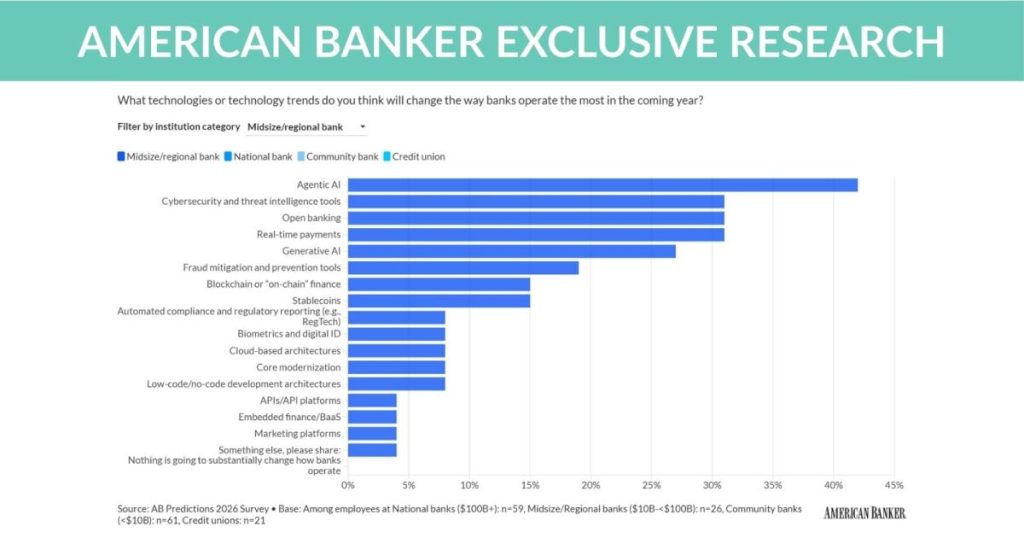
The technology driving change in the banking industry
Regional bankers said they expect agentic AI models (42%) will drive the most change in the banking industry across 2026. Real time payments (31%), open banking (31%) and cybersecurity tools (31%) were all close behind, followed by generative AI (27%).
Agentic AI was also the top pick for national bankers (36%), while community bankers responded with stablecoins (44%) and credit union leaders said generative AI (43%).
Agentic AI models are at the forefront of the technology race, with institutions like
In speaking at American Banker’s Most Powerful Women in Banking conference last October, Teresa Heitsenrether, chief data and analytics officer at JPMorganChase, said that the evolution of these models has “allowed them to reason” when searching for the answer to an issue, making data and oversight a key driver of success.
“There’s a lot of thinking that has to go on, because what you have now is much more direct connections of machines speaking to machines,” Heitsenrether said. “While people can handle ambiguity when you’re talking about the way you call an account or data, or what have you, machines don’t do so well with that. It’s a very new paradigm and I think there’s a lot of work that has to happen before we see this really standing up.”
Key takeaway: Agentic AI is eyed by regional bankers as a major driving force of change in the banking industry for 2026.
The looming threat of wire transfer fraud for midsize banks
Fraud in all forms has continued to be a sticking point for bankers in 2026, and some schemes are more problematic than others.
Wire transfer fraud is eyed as the biggest scam threat for regional bankers (46%) in 2026, while some community bankers (28%), national bankers (22%) and credit unions (19%) agreed.
The problem with
Blake Roberts, partner at the global law firm Eversheds Sutherland and former deputy general counsel of the U.S. Department of Commerce, told American Banker that when the vulnerability is “human judgment, layers of security can only do so much.”
“Financial institutions can raise flags and block transactions, but a motivated victim can disregard warnings or shift their assets,” Roberts said. “The challenge will grow as scammers adopt new technology, like AI and deepfakes, to trick victims. To address this challenge, financial institutions should consider expanding a control they have used for decades, if not centuries: dual approval.”
Key takeaway: Close to half of regional bankers are most worried about wire transfer fraud impacting their organization in 2026.