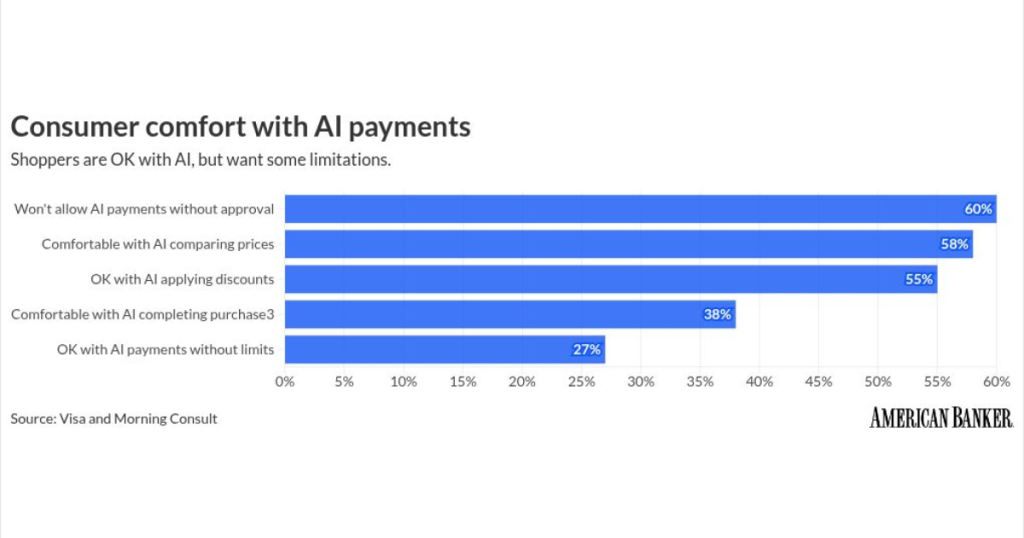
- Key insights: Visa and Mastercard Visa have debuted new products that use agentic artificial intelligence.
- What’s at stake: The card networks’ moves will make agentic AI more widely available to merchants and card issuers.
- Forward look: Visa’s research says AI-to-AI commerce is poised to expand in coming years.
Processing Content
Visa on Wednesday announced an AI-supported program to improve payment disputes and a partnership with Ramp to automate corporate bill payments. Separately, Mastercard said it has expanded agentic payments to Hong Kong, part of a broader goal to create an
“Visa and Mastercard adoption of agentic capability adds credibility and usability to this new technology. Integrating with payment tools that most consumers already have makes adoption of this new technology much easier and more likely to grow,” Tony DeSanctis, senior director at Cornerstone Advisors, told American Banker.
Settling disputes and paying bills
The rollouts at Visa and Mastercard are focused on agentic AI, or a form of AI that performs tasks with little or no human supervision.
Visa made two moves this week. The card network launched new resolution tools designed to manage administrative and fraud losses due to payment disputes, which Visa said is one of the most persistent sources of friction in commerce. Visa processed more than 106 million disputes globally in 2025, according to a Visa release, noting that’s up 35% since 2019.
“Disputes put strain on every part of the payments ecosystem, frustrating consumers, while driving cost and complexity for merchants and financial institutions,” said
Visa will sell the new dispute tools to its issuers, which will offer the technology to merchants. Visa will also sell directly to merchants. AI will auto-populate responses to dispute questionnaires. The card network will also sell a centralized platform to manage disputes across different card networks, ranging from the dispute’s intake to resolution.Visa’s release comes as dispute management becomes more of a strategic priority than a back office function, driven by rising volumes, regulatory scrutiny and growing pressure to protect customer experience, according to Sam Abadir, a research director at IDC Financial Insights, in a release.
Visa is also using agentic AI to streamline corporate bill payment. The card network and fintech Ramp will use Visa’s “trusted agent protocol,” or a method of vetting AI agents, and Ramp’s network of more than 50,000 corporate clients to sell a platform that combines corporate, expense management, bill presentment and payment, travel booking, treasury and bookkeeping.
The new suite of AI agents will provide Ramp customers with greater payment flexibility and more control over corporate spending, according to Colin Kennedy, chief business officer at Ramp. “The best financial systems don’t add controls after the fact — they build them into every transaction,” Kennedy said in a release. “That’s what we’re delivering with Visa.”
Visa may have competition from AI that people use independently. The card brand’s moves this week are examples of things that people may do themselves with independent AI agents like OpenClaw or upcoming apps from Anthropic and OpenAI, Aaron McPherson principal at AFM Consulting, told American Banker, adding the the question is whether an integrated AI agent capability from an incumbent will be more appealing than using an independent agent to work with multiple providers.
“I think the advantage is on the independent agent side, because you have the usual contrast between an insurgent startup whose only focus is on providing a great agent experience, versus an incumbent who is encumbered by the need to service customers in both agentic mode and traditional human-oriented [models],” McPherson said.
Visa’s rival Mastercard also advanced its agentic commerce ambitions this week, executing its first agentic payment in Hong Kong. The Hong Kong transaction included booking and paying for a ride share from Hong Kong’s airport via an AI agent. The payment used Mastercard’s protocol to authorize AI agents with HSBC acting as the partner bank.
“We’re enabling HSBC credit and debit card customers to pay more seamlessly and embrace new experiences, all built on a foundation of clear consent, transparency, and robust safeguards,” Janet Pang, head of retail business, retail banking and wealth in Hong Kong for HSBC, said in a release.
Mastercard, which launched its agent AI protocol in late 2025 as part of a series of
Where’s the demand?
Visa’s product rollouts were accompanied by research on AI usage the card network released Thursday morning.
Conducted in conjunction with Morning Consult, Visa’s report on what it calls “business-to-AI technology” — where AI is a participant in transactions — contends there is strong demand for AI’s participation in commerce. Nearly 40% of Americans have made a purchase they normally would not have considered as a result of using an AI agent, according to Visa, which says this is an early indication that intelligent systems are beginning to shape how people discover and decide what to buy.
The report also says 53% of U.S. businesses in the survey would allow AI agents to negotiate prices or terms directly with other AI agents on their behalf, signaling that AI-to-AI commerce is poised to scale. And Visa reports 71% of businesses say they are willing to optimize products, offers and experiences specifically for AI agents, while 77% are already using or piloting AI in their operations.
Other research suggests increasing comfort with using AI to engage with financial services. Fifty five percent of Americans asked large language models for financial advice in 2025, up from 10% in 2024, according to
“Visa’s B2AI research makes clear that demand for agentic commerce is already here,” Visa’s public relations office said in an email. “Use cases like payment dispute resolution and corporate bill pay are natural next steps, and the data shows they will scale fastest when backed by trusted financial infrastructure.”