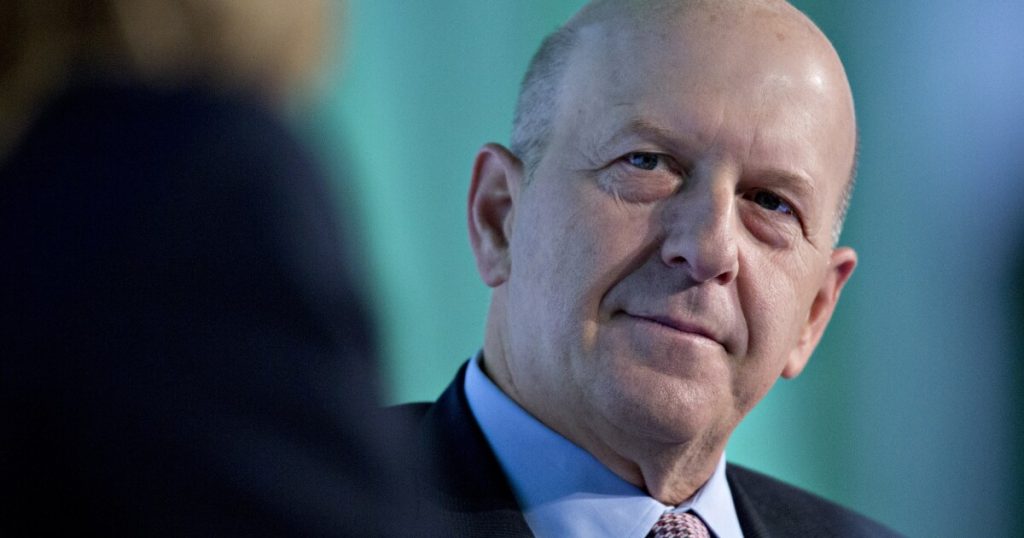
- Key Insight: Even as Goldman Sachs posted a forecast-beating first quarter, CEO David Solomon warned that the war in Iran could drive up U.S. inflation.
- Supporting Data: Earnings per share for the investment banking giant reached $17.55, well above analysts’ consensus estimate of $16.39.
- Expert Quote: “The geopolitical landscape remains very complex, and the ultimate impact of higher energy prices on inflation and growth has yet to be determined,” Solomon said.
Processing Content
“Things rarely move in a straight line, and as the quarter progressed, the macro environment started to weigh on sentiment,” Solomon said during a call with analysts. “Volatility increased meaningfully amid concerns around AI-driven disruption in sectors like software, heightened uncertainty in parts of private credit and the conflict in the Middle East.”
In the first quarter of 2026,
But the quarter also included the start of the current war in Iran, which the United States and Israel launched on Feb. 28. The conflict in the oil-rich region, which has largely closed the Strait of Hormuz to traffic, has caused a spike in energy prices and many related costs. Just last week, new data from the Bureau of Labor Statistics showed a
During Monday’s call, Solomon acknowledged that the war’s full impact on commodity prices has not yet been felt, and could potentially last well into the year.
“My guess is to the degree that energy prices remain high, you will see that translate through a little bit,” he said. “At this point, the underlying economy still remains relatively robust. But if the resolution of the conflict drags, that probably will be a headwind in some of these areas, particularly inflation trends as we get further into the second and the third quarter.”
Over the past year and a half,
In January 2025, Solomon noted a
One quarter into 2026, Solomon mostly maintained that optimism, calling the current environment “a pretty constructive investment banking ecosystem.”
In particular,
“We’re encouraged by the direction of regulatory reform, including the recent Basel III finalization and G-SIB surcharge re-proposals,” Solomon said. “While the rulemaking process is still underway, and we plan to participate in the comment period, we believe this direction is positive for the banking system as a whole.”
At the end of the first quarter,
Balancing the constructive regulatory changes, Solomon said, is the upward pressure on prices emanating from the Strait of Hormuz.
“The geopolitical landscape remains very complex, and the ultimate impact of higher energy prices on inflation and growth has yet to be determined,” Solomon said.
A golden first quarter
In spite of the tumultuous geopolitical backdrop,
One highlight was
“It was the best Global Banking and Markets quarter ever for the firm,” Solomon said.
Meanwhile, the bank also continued to shed the baggage of its ill-fated foray into consumer banking. In the first quarter of 2026, its Platform Solutions unit, which contains remnants of the consumer banking initiative, earned net revenue of $411 million — a 33% drop from one year ago, but up from a loss of $1.68 billion
In January,