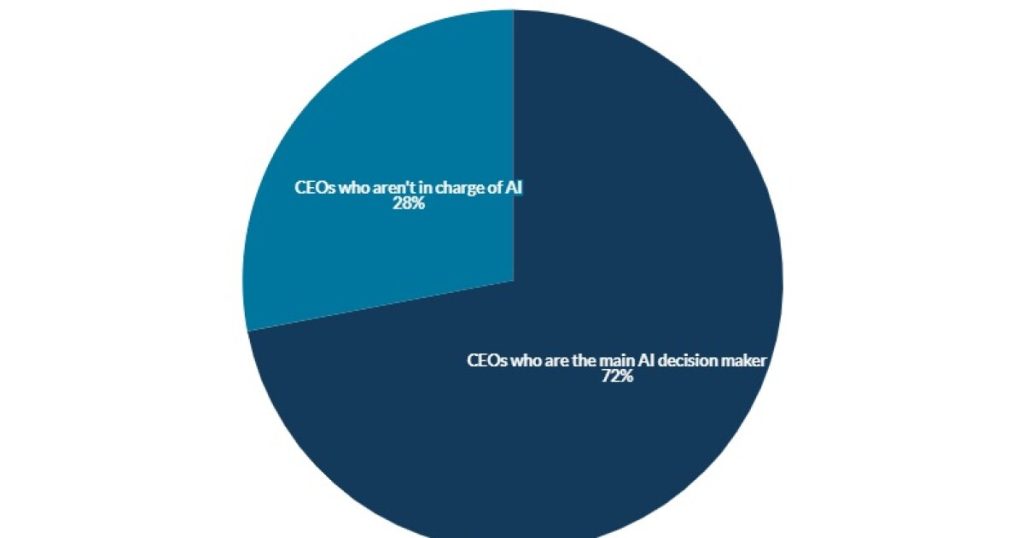
Historically, chief executive officers have not put themselves in charge of technology. Outside of the technology sector, techies rarely make it to the CEO seat and chief executives generally leave the details of tech projects to the tech experts and leaders such as chief information officers and chief technology officers.
Processing Content
But with the widespread adoption of advanced artificial intelligence, including generative and agentic AI, more CEOs appear to be putting themselves in the AI driver’s seat.
A recent survey conducted by Boston Consulting Group found that 70% of bank CEOs say they are the main decision makers in AI within their organization. More than half (54%) say their job stability depends on them getting AI investments and strategy right. And financial institution CEOs say they spend on average almost seven hours a week expanding their knowledge on AI.
“CEOs are leaning in,” Vladimir Lukić, the global leader for Boston Consulting Group’s Tech and Digital Advantage practice, told American Banker. CEOs are “realizing that to drive the change, things will be on their desk, and they will need to have hard conversations that usually involve changing the personnel or having really hard, difficult discussions with the business owners.” This is taxing on CEOs’ time and emotions, he said.
“They’re spending a lot of time on this,” he said.
To remove bottlenecks
One reason CEOs are taking the lead on AI is to break through the operational hurdles and fiefdoms all companies have.
“Where we see success, usually it’s because the CEO leaned in to eliminate internal obstacles to give license to change standard operating procedures, license to change incentives for people that are in different roles,” Lukić said.
CEOs who have been experimenting with AI with limited results “are realizing that if they don’t lean in, things are not going to be unlocked, so they’re starting to lean in and drive it more,” Lukić said.
“I think the reason bank executives may be more engaged in leading AI efforts isn’t just the significant investment they are responsible for, it’s the very nature of the technology itself,” Bradley Leimer, former head of innovation at Santander Bank and principal consultant at Leimer One Advisors.
“Leaders can feel it,” he said. “They can use it to write, analyze, plan, communicate, and make decisions by leveraging data in new ways. AI isn’t just about infrastructure, it can change how each role works. That definitely includes the role of the CEO. So this is really a profound shift. AI reaches across functions, teams, silos, and decisions, influencing how strategy is developed, how information is understood, how talent is developed and deployed, and how work itself is defined. That makes it difficult, and frankly a little risky. This can’t be fully delegated.”
To reap efficiency and returns
Some CEOs hope to have their organization do all the things it does today with 50% of the staff, or “double the growth or the size of the bank without having to add a single person,” Lukić said. “That is appealing to them. That is interesting to them.”
There’s a lot of money going into this hope: 46% said they expect to invest more than $50 million on AI in 2026. They estimate an average of 2% of their organization’s total revenue will be invested in AI. About a third of this AI investment (32%) is going into AI agents.
At Grasshopper Bank, CEO Mike Butler formed an efficiency committee that looks for ways people can use AI to save time.
“Everybody started to give a whole bunch of ideas and thoughts about how to [use AI to] make their lives easier,” Butler told American Banker. “And we started to see the adoption increase dramatically.”
Recently the team found ways to use AI in compliance and saved not only hours, but the need to buy new regtech software.
To get everyone on board
“There is a cultural element to this that we can’t ignore,” Butler said. “Getting everybody engaged is really important. I feel I owe it to my employees to get them to engage in AI, because if they don’t, over time, they’ll be under-performers or under-producers and won’t have a job.”
For Butler, a big part of getting employees on board as a CEO is removing the fear that AI will take their jobs.
“There is still fear of job loss. There’s no doubt about it,” Butler said. “We’ve reduced that fear by making it crystal clear that this isn’t about job reductions, but is about efficiency and maybe not hiring the next person. There’s a difference between saying ‘I’m going to cut 24 people’ versus ‘I’m not worrying about hiring the next 24.’ That’s where I think we’ve been able to make progress. People aren’t as concerned about job loss. They know that their job is safe, and they also know that if they’re engaged in bringing ideas to the forefront and are leading with it, then they’re going to be considered an influencer and a positive part of the culture of the organization.”
Grasshopper provided Google Gemini to all employees and began monitoring their use of it. He could see the power users who love it and the people who don’t use it. The bank provided training sessions on it, then started to see a big uptick in AI use.
To improve client engagement
Grasshopper’s next phase for AI is improving client interfaces with it. The bank recently rolled out a product that lets small business clients interact with AI to understand their cash flows from their business account.
“How sticky is that, from the perspective of retaining a client?” Butler said. “How could they ever go to another bank that doesn’t have that? And for the technophile and that type of digital client that wants to join the organization, that tool set is an incredible attraction.”
The end game for Grasshopper is “to be an organization that leverages this tool to be able to get turnaround times better on your credit decisions, to answer questions from clients quicker and easier and maybe without people but accurate, to be able to give them tools to understand their business account better, that’s important.”
To make decisions for the company’s future
Lukić attends Davos every year. Usually he meets with CIOs, CTOs and chief data officers. This year, almost all his conversations were with CEOs. “They wanted to talk to me, and they went into technical details,” he said.
Some CEOs asked him about the differences between hyperscalers and the performance and cost of various models, to have an informed point of view on which direction to steer the organization.
“They’re realizing that the technical teams can be very religious about a specific tech stack,” Lukić said. “Because if I spend my whole life in a specific tech stack, and I’m comfortable with it, and I know how hard it will be to migrate into a different stack, I can actually include all of this into that tech stack. But I’m limiting a lot of other options for the company downstream.”
Meanwhile, many bank CEOs are stuck with tech debt from decisions made by tech teams 15 or 20 years ago that are costly to unwind, he said. “They’re realizing some of these technical decisions now will have a ripple effect 20 years down the line, as well as the next three to five years.”
FOMO and board pressure
Some CEOs attend AI forums and have a fear of missing out, Lukić said.
“They’re like, okay, look, others are doing it, even if I don’t fully get it,” he said. “There is a bucket of them that feel they’re missing out on something if they don’t lean in.”
And some are taking the reins on AI as a defensive play, thinking, “we’ve got to do this because there is pressure from the board and others to demonstrate we’re doing something,” Lukić said.