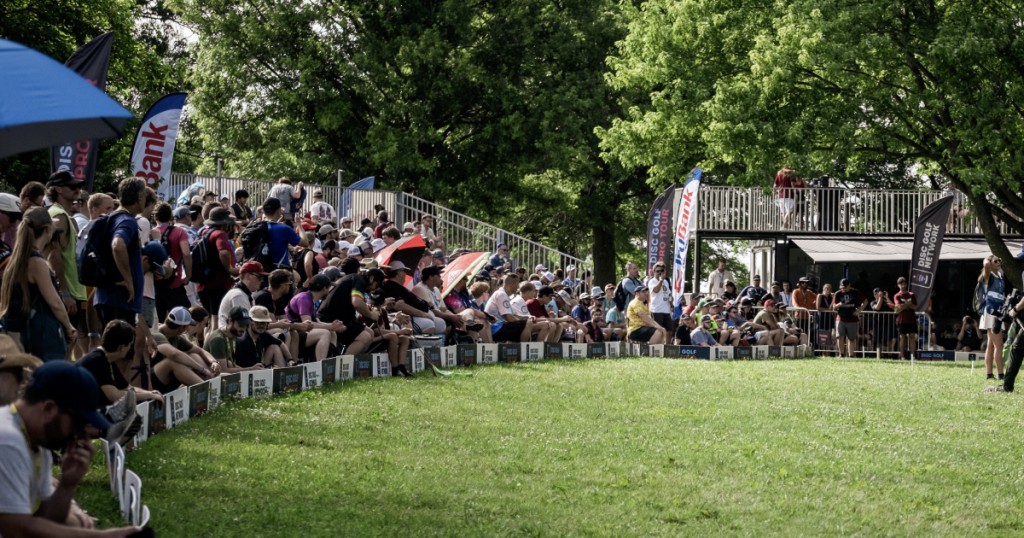
Key takeaway: Some community banks have found sponsorship of disc-golf clubs and events as effective ways of generating local engagement.
Processing Content
Supporting data: Disc golf has ballooned in popularity since the COVID pandemic, with more than 1.25 million players logging rounds in 2024.
Expert quote: “A lot of times … you’re the difference between something happening and not happening, and so it becomes a lot less about the bank, and the focus becomes about the community.” — Peter Nelson, senior vice president of member engagement, Independent Community Bankers of America
When Ben Currie was approached to sponsor a disc golf tournament (if you haven’t heard of this, it’s okay; we’ll explain), his response wasn’t as skeptical as one might think.
Currie, chief financial officer of Indianola, Iowa-based
“We just said, ‘Hey, we love what you’re doing,'” Currie said. “The economic impact it brings to the community, all the 180 professional players who will come in, as well as all the spectators … so we said yeah. What we love is supporting those local organizations that bring something unique, bring economic impact to the community.”
The event in question was the
“Without TruBank’s support of this event, and several other events, there would be far fewer opportunities drawing visitors to Indianola, which directly affects the ability of local businesses to survive and grow,” Tannatt said in an email. “From 2021 through 2024, it’s fair to say that hosting a truly successful event would have been extremely difficult without TruBank. While it may have been possible to run a lower-tier DGPT event, there is little chance it would be regarded as one of the premier stops on tour without their backing and commitment.”
Gannon Buhr, the 2025 PDGA World Champion and highest-ranked disc golf player in the world, grew up near Des Moines and says he’s seen TruBank’s support translate into a better disc golf experience for both players during the event and all year-round.
“Having them show their support means a lot to the disc golf community, and it helps us to be able to achieve certain things on the course — whether that’s infrastructure and stuff like that, money going toward the course, help create new designs and new holes. It’s really good to have someone like that having your back,” Buhr said. “When I first started playing, it was just bad baskets on the ground with teepads, not much to it. Over the last five years it’s changed so much — I think, for the better — every single time.”
A good walk spoiled
For those unfamiliar with the sport, it is in many ways similar to its ball-based cousin, and yet in other ways antithetical. Gameplay is virtually identical to ball golf: the object is to get the thing into the other thing with as little effort as possible. Each hole has a par rating, and total strokes are tallied at the end of the round, yielding a score that reads like a ball-golf score.
But that is where the similarities end. Ball golf, of course, involves hitting a small white ball with a club into a small hole in the ground. Disc golf involves throwing a
Disc Golf Pro Tour
That distinction has rather profound implications for the landscapes on which disc golf is played versus ball golf. Ball golf requires open fairway lanes, closely trimmed and attentively watered greens and constant maintenance — all of which means higher costs, which is part of why ball golf is expensive to play. The best disc golf courses, by contrast,
Tannatt said that what this means for banks — particularly community banks — is that disc golf presents an opportunity to create or enhance a public resource that the community can use not only for special events, but all year round.
“This is a long-term effort,” Tannatt said. “The sport continues to grow steadily, and our goal is to build sustainable momentum. Over the past four years, we’ve invested $50,000 into [the tournament course] alone, and we hope continued growth will allow us to match or exceed that investment over the next four years. All of these funds are reinvested into public disc golf courses where anyone can play for free. Ultimately, this is about expanding access to an outdoor sport with a very low barrier to entry, encouraging people to get outside, and creating something families and friends can enjoy together.”
All that makes disc golf different from its cousin, famously and derisively described as a “good walk, spoiled.” Disc golf is undergoing a kind of transformation from a dangerously uncool
Disc golf in its modern form was created in
And it seems that many of those new players that found the sport during COVID are sticking around — according to
It may not sound like it, but the tournaments can be very dramatic. The first year that TruBank sponsored the Des Moines Challenge, the tournament ended in a tie, resulting in a playoff. As in ball golf tournaments, the tied players play additional holes until a winner emerges, and

Disc Golf Pro Tour
“That first year — even me, I was hooked,” Currie said. “None of us disc golfed, none of us knew what the course was. It was just electric, and we said we wanted to continue on it. And they’ve continued to build that tournament bigger and better every year. They’ve done a ton of work to make that course better — better for the players, but really for the spectators, too. And Trubank is just happy to continue to support it. We like what it brings with it.”
Trubank upped its sponsorship contribution to $30,000 the next year. It has given $130,000 in total since 2022.
Ezra Aderhold, a professional disc golfer who won the 2025 Discraft Open presented by TruBank, said that sponsorships also help boost the payouts for these major events, and those payouts draw bigger names in the sport, which in turn drive up attendance and build momentum behind the event and the community.
“One of the biggest things for the sport — being pretty niche and not as prominent as some other sports here in America — I think is having the payouts continue to go up,” Aderhold said. “Getting more main sponsorships and getting that to grow is really going to help with the legitimacy of it.”
Putting a price on community engagement
Big-time pro-tour event sponsorships like the one TruBank undertook for the Des Moines Challenge — which was renamed the Discmania Challenge Presented by TruBank in 2025 — may not present themselves to community banks every day, but banks certainly sponsor sporting events all the time.
Banks
Peter Nelson, senior executive vice president of member engagement at the Independent Community Bankers of America and former head of Glenwood State Bank in Glenwood, Minn., said that while the Masters and the Des Moines Challenge are both sporting events, the business case for either sponsorship is fundamentally different. Sponsoring the Masters is a bid for visibility in front of a certain demographic — namely those with high net worth, wealth that perhaps Bank of America would like to manage — whereas community banks evaluating whether to sponsor a local event are considering a different metric of success.
“They’re affiliating themselves with the affluent — ‘If you’re a part of this, you should think about Bank of America,” Nelson said. “That’s not really what a community bank thinks about. It’s really the person, not the balance sheet, that we care about.”
Community banks get approached with pitches for sponsorships and events all the time, Nelson said, and when that happens, bankers tend to view the transaction through a lens of helping the community create something that might not otherwise be there.
“When it comes to advertisement, marketing or giving back to your community, there’s a lot of things to think about. The advertising piece is actually very small — most of the time where community banks exist, they know they exist, so what you’re trying to do is make sure they know, ‘I’m all in on this community,’ Nelson said. “A lot of times, what those end up being, is you’re the difference between something happening and not happening. And so it becomes a lot less about the bank, and the focus becomes about the community.”
Currie at TruBank said his bank is indeed approached with similar sponsorship opportunities, and the disc golf tournament isn’t even the biggest niche sport sponsorship it does; TruBank also sponsors the

Disc Golf Pro Tour
What those events all have in common is that they are tentpole community events and foundations, Currie said, but the sponsorship of the disc golf event has given the bank a visibility and recognition in the national disc golfing community that they might not otherwise have had.
The bank doesn’t have a specific return metric upon which the investment is judged, Currie said. “What I love, and why we continue to support it, is because the disc golf community is so tight-knit and supportive of each other, [such] that they are much more open to saying ‘thank you’ than anywhere else. We do stuff with 4H and the [Future Farmers of America] and we get kids who send in a thank you, but I’ve seen it way more [with disc golf], and I think that’s because of the community that it has.”
Aderhold echoed that sentiment, saying that disc golfers do tend to notice who sponsors events, especially if those companies aren’t inherently disc golf-related companies. He said pros even go out of their way to support companies that sponsor disc golf as a kind of mutual recognition of affection for the sport.
“We do appreciate it when we have new sponsors pop up, or we have ones that are outside the sport, not just disc golf-specific … that stands out to us,” Aderhold said. “We have this other entity that is showing an interest in disc golf, and we always think that’s super cool. And we’ll talk about that as pros, too — when a company takes an interest in disc golf, a lot of times we’re more apt to support them as well, because we want to help each other out that way.”
Tannatt said that TruBank’s investment in the community — both with the event and the improvements to the local courses that the investment funds — is greatly appreciated by the community because a little sponsorship goes a long way. That’s something that other banks can think about when considering public outreach efforts.
“I believe a bank’s support of a disc golf event should be viewed first and foremost as an investment in the local community,” Tannatt said. “This event generates more than $1 million in economic impact for the area, with lasting benefits beyond the event week itself. Disc golfers from across the country travel specifically to play courses that have been featured on the Disc Golf Pro Tour, which creates ongoing tourism and visibility. It’s also a unique model within sports, as the course remains free and open to the public year-round. Very few sports offer that kind of long-term public access.”
Buhr said that the main thing banks should remember when considering disc golf sponsorships is that the sport is a community first and foremost. The thousands of public courses that are free to play are largely maintained by local clubs and volunteer labor and coordination, he said, and sponsoring a single event or project creates a sense of common cause between the bank and the community.
“The community is just so tight. People just want to be together, and they care,” Buhr said. “You have people working hundreds of hours on the course, complete volunteer work, because they care about disc golf. It’s a very dedicated community, I’d say.”
In the case of TruBank’s sponsorship, he said, the disc golf community saw the bank’s enthusiasm and recognition and have responded in kind.
“It’s kind of like the disc golf community — they just trusted us, and went all in, just like how the disc golf players would as well,” Buhr said. “It’s cool to have a big company like that match the energy of what the players think, and it means a lot to us.”