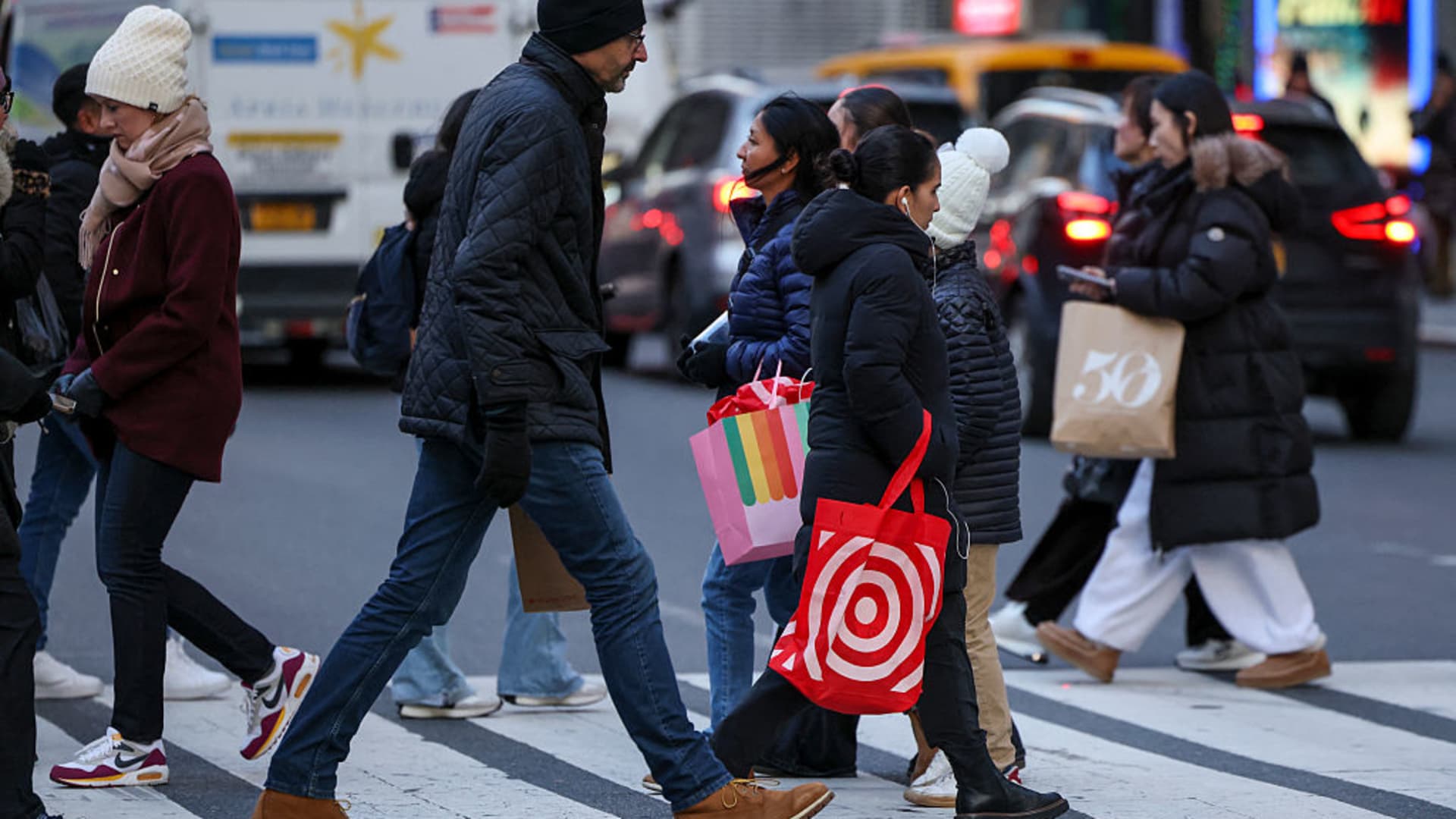
People hold shopping bags as they make their way through Herald Square in New York, Dec. 11, 2025.
Angela Weiss | AFP | Getty Images
Americans are slightly more bullish about 2026, according to a New York Federal Reserve survey released Thursday.
The central bank’s monthly Survey of Consumer Expectations found that consumers expect inflation to be higher in the short term, but households, overall, are more optimistic about their future financial standing.
Perceptions about current financial conditions and year-ahead expectations both improved, with a smaller share of Americans expecting a worsening financial situation and a larger share expecting an improved financial situation one year from now, the New York Fed’s survey found.
However, there are also pockets of concern: Delinquency expectations deteriorated, rising to the highest level since the start of the pandemic, according to the survey.
The perceived probability of missing a minimum debt payment in the months ahead rose to 15.3%, the highest level since April 2020. The increase was most pronounced among individuals over the age of 60, those without a college degree and those with annual household incomes below $50,000, the New York Fed’s survey found. Across all age and education levels, job loss expectations also worsened.
“If you’re not sure about your own job security, it makes it hard to focus on any other financial goals,” said Matt Schulz, chief consumer finance analyst at LendingTree.
Delinquency rates increased across the board in December, the most recent U.S. Household Credit Report from Moody’s Analytics also found. Delinquencies may continue to rise in the months ahead, the report said, “as increased joblessness strains household budgets.”
According to a separate report by the Conference Board, consumers’ views of their current financial situation in December “collapsed” into negative territory for the first time since July 2022, the month after pandemic-era inflation had peaked.
The Conference Board’s expectations index, which is based on consumers’ short-term economic outlook, held steady at 70.7 — well below the 80 level considered a signal for a recession ahead.
Meanwhile, consumers are tapping additional liquidity even as they worry about falling into the red. Credit card balances keep edging higher, according to recent reports by TransUnion and VantageScore.
The K-shaped economy
In an increasingly bifurcated consumer economy, credit card debt widens the divide, according to Ted Rossman, senior industry analyst at Bankrate.
Roughly 175 million consumers have credit cards. While some pay off the balance every month, about 60% of credit card users have revolving debt, according to the New York Fed.
In the so-called K-shaped economy, some borrowers are struggling to keep up while others have strengthened their financial position, largely by benefiting from stock market gains and appreciating home values.
“The K-shaped economy is an important part of the context,” Rossman said in an email. “With stocks and home prices at record levels, that’s benefiting the ~65% of Americans who own homes and the ~60% who own stocks, but not everyone is sharing in that.”