American Banker’s 2026 Predictions Report
American Banker’s 2026 Predictions report was fielded online during October and November of 2025 among 174 banking professionals who work across a variety of executive roles at banks, credit unions, neobanks and payments companies.
Top findings from the report
Results from the report are highlighted below using interactive charts. Mouse over each section for more detail, click on the chart labels to show or hide sections and use the arrows to cycle between chart views.
Results from the report are highlighted below using interactive charts. Mouse over each section for more detail, click on the chart labels to show or hide sections and use the arrows to cycle between chart views.
Processing Content
This item is part of a series diving into new data from American Banker, so check back for the latest updates.
Top tech spending priorities for bankers in 2026
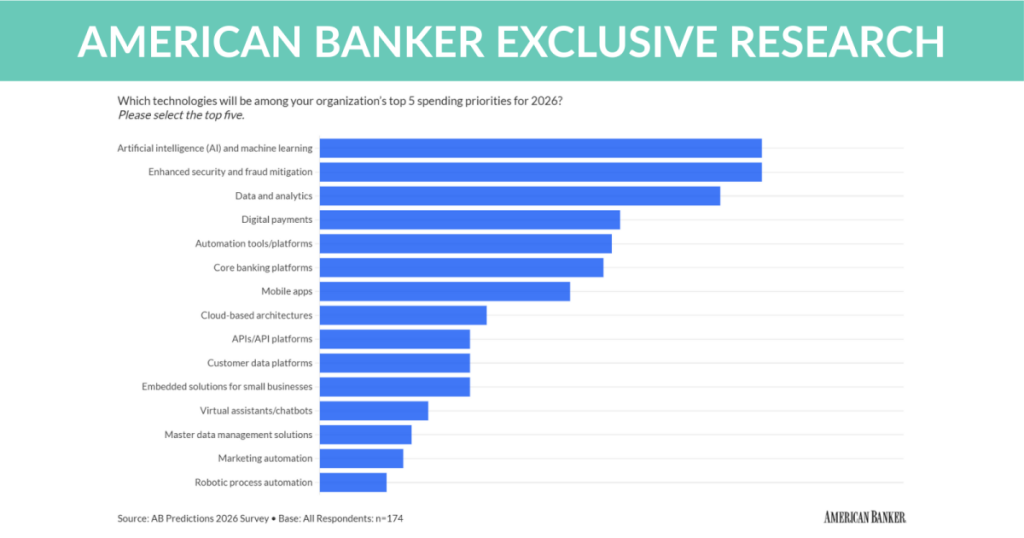
Bankers are kicking off budgeting for tech spending in the year ahead. Understandably, artificial intelligence and machine learning are at the top of the list.
Fifty-three percent of respondents identified AI and machine learning as among the top five spending priorities for their organization in 2026, 53% also said enhanced security and fraud mitigation were their high-priority budget items.
One such iteration of AI that grew in popularity throughout 2025 was agentic AI, which unlike more standard forms of AI are models designed to operate almost autonomously with minimized human intervention.
Last year, Citizens Financial Group CEO Bruce Van Saun announced the bank was
In speaking with American Banker, Michael Ruttledge, chief information officer at Citizens and the driver behind much of the bank’s reimagining, said there are roughly 47 various use cases for AI across the bank that range from agentic to simple business-process reshaping.
“There’s still a lot of proof-of-concepts happening right now, and a lot of test-and-learn,” Ruttledge said during an interview at a Citizens office in New York City. “But the types of use cases we’ve seen are where there’s manual processes today that we think we can automate.”
Further down the list of bankers’ tech priorities were data and analytics (48%), digital payments (36%), automation tools/platforms (35%), core banking platforms (34%) and mobile apps (30%).
Breaking down these responses on an institutional level reveals an interesting split in priorities. While AI and machine learning had the greatest share of respondents from national and midsized/regional banks, enhanced security and fraud mitigation was the top area for community banks (66%) and credit unions (57%).
Key takeaway: AI and fraud mitigation are the top two tech areas for bank tech spending in 2026.
Stablecoins, crypto to shake up payments
Digital assets are forecasted to be the main changemaker in payments for 2026.
Roughly 58% of bankers surveyed said stablecoins and cryptocurrencies were the technological trend that stands to change payments the most in the coming year, followed by real-time payments with 43% and payment tokenization with 27% to round out the top three.
In July, President Trump
Banking advocacy groups were quick to
Since then, firms like Coinbase have
Other top technology trends poised to change payments include Buy Now Pay Later (24%), mobile wallets (21%), international/cross-border payments (17%), biometric payments (16%) and agentic payments (13%). Agentic payments are transactions conducted by AI on behalf of a human consumer.
Key takeaway: Stablecoins and crypto are the top changemakers in payments for the year ahead.
Bankers see AI pushing technological change
Comparing these findings to those in the first chart, it makes sense that generative and agentic AI tools are the top technologies poised to change bank operations in the near future.
As with the earlier question about spending, financial institutions have earmarked AI as the top technology for changing operations in 2026, with generative AI at 36% of respondents and agentic AI at 30%.
Last year saw many banks
In the survey, cybersecurity and threat intelligence tools ranked third with 29% of respondents, followed by stablecoins with 28%, real-time payments with 24% and fraud mitigation and prevention tools with 22%.
Key takeaway: Generative and agentic AI are the most transformational technologies for 2026.
Are AI-based fraud tools the most effective?
Fraud was a major thorn in banks’ side throughout 2025, and 2026 is shaping up to be no different.
When ranking the impact of AI this year, fraud detection and mitigation was the use case identified the most by bankers surveyed, at 53% of respondents. Back-office automation and customer service and support were tied for second at 39%, followed by risk management and compliance monitoring at 30%.
As one example, the U.K.-based Starling Bank
Separately, Santander’s U.K. arm launched a
Further down the list were use cases such as scam prevention and customer protection (25%), personalized customer engagement (22%) and account opening and onboarding (21%).
Breaking these figures down by respondent class, it’s clear that banks and credit unions of all sizes are most optimistic about AI’s impact on fraud detection and mitigation. The category was the top pick for 44% of national bankers, 54% of midsized/regional bankers, 66% of community bankers and 43% of credit unions.
Key takeaway: Bankers’ worries about fraud are continuing from 2025 into 2026.
Real-time payments seen as a lure for fraud
Even as AI is poised to be a big tool in the fight against fraud, the same technology is similarly empowering fraudsters.
In particular, 41% of respondents said real-time payments fraud (e.g., Zelle, FedNow, TCH) stands to have the biggest negative impact on their organization in 2026, making that category the most problematic. Identity theft, check fraud and card fraud were all tied for second, with each getting 30% of respondents.
New York Attorney General Letitia James
“No one should be left to fend for themselves after falling victim to a scam,” James said in a
A Zelle spokesman told American Banker at the time that the lawsuit was “a political stunt to generate press.”
Even so, RTP fraud seems to be the top fraud concern for national and community bankers, at 51% and 41% respectively. Midsized and regionals were more concerned about identity theft (31%) and credit unions were jointly worried about identity theft and account takeover fraud (both 52%).
Key takeaway: Real-time-payments fraud is shaping up to be the most challenging type of scam for bankers to defend against.