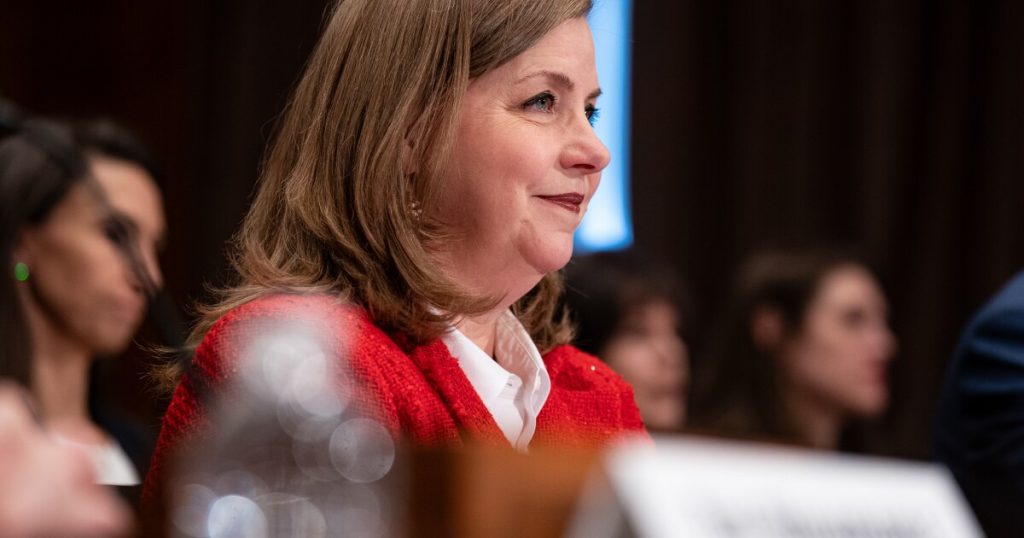
- Key Insight: Federal Reserve Vice Chair for Supervision Michelle Bowman said the discount window should serve as a credible and routine liquidity backstop for banks, not as a facility that is avoided because of stigma or regulatory consequences.
- Expert quote: “Some see tension between monetary policy implementation tools and regulatory objectives. In my mind, these goals should be compatible if we are modernizing the discount window to serve as an effective liquidity backstop, instead of a theoretical option.” — Fed Vice Chair for Supervision Michelle Bowman.
- Forward look: Fed watchers say the discount window, which allows banks to borrow short-term liquidity against high-quality collateral, is outdated and ill-suited for modern liquidity crises.
WASHINGTON — Federal Reserve Vice Chair for Supervision Michelle Bowman said in a speech Tuesday that the central bank is mulling changes to the central bank’s discount window, which she said has been ineffective in its stated goals.
Processing Content
Speaking at an event sponsored by the Committee on Capital Markets Regulation, Bowman called the facility a “critical but underutilized tool, one that requires fundamental reform.”
Bowman said banks avoid using the discount window even during periods of financial strain because it is the lender of last resort, potentially implying to the market that a bank acquiring liquidity from the discount window is in trouble.
“Banks avoid the discount window, even in times of stress, because of the stigma that disclosure and higher borrowing costs present,” she said. “Markets interpret any usage as a sign of fragility. These factors combine to discourage banks from using the facility precisely when they may need it most.”
Bowman said the discount window needs “fundamental reform,” including streamlined rules and processes across the Fed’s 12 regional Reserve Banks. She said variations in procedures create “uncertainty for borrowers” and could “exacerbate fragilities in the banking system.”
“[The discount window] should function as a liquidity backstop with consistent rules, processes, and procedures,” Bowman said. “Currently, each of the 12 Reserve Banks has their own rules and processes and an independent ability to make lending decisions — decisions that may vary across Reserve Banks for similarly situated borrowers and similar collateral.”
The Fed’s top regulator argued that the current system encourages banks to hoard high-quality liquid assets instead of lending, reducing credit availability in the broader economy.
“By increasing the demand for reserves, it also requires the Fed to maintain a larger balance sheet to meet that demand,” she said.
Bowman said that if the discount window functions as a credible and routine liquidity backstop for banks, regulatory safety requirements and monetary policy implementation need not conflict.
“Some see tension between monetary policy implementation tools and regulatory objectives,” she said. “In my mind, these goals should be compatible if we are modernizing the discount window to serve as an effective liquidity backstop, instead of a theoretical option.”
Fed watchers have
Bowman also criticized the liquidity coverage ratio, designed to ensure banks hold high-quality liquid assets for short-term resilience. She said it is too rigid and ignores how banks actually raise funds under stress.
“Banks have strong incentives to convert less liquid assets, like loans, into cash to meet withdrawal and repayment demands,” Bowman said. “They routinely pledge collateral to secure liquidity through Federal Home Loan Bank advances. Yet, the LCR does not provide credit for this collateral for a number of reasons, including uncertainty around availability and valuation.”
The liquidity framework produces strong incentives for banks to engage in “liquidity hoarding,” she said.
“Maintaining liquidity resources in excessive amounts may impose unnecessary costs on the banking system and the broader U.S. economy,” said Bowman. “As we consider changes, we must carefully consider the consequences — both intended and unintended.”