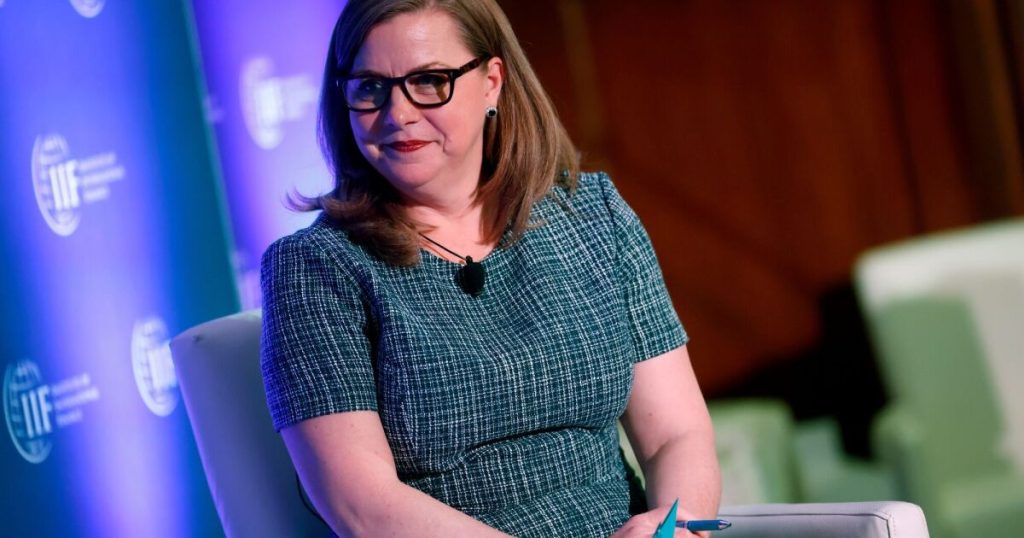
- Key insight: Federal Reserve Vice Chair for Supervision Michelle Bowman said the central bank’s forthcoming proposals to modernize liquidity rules and facilities will take into account a broader goal of reducing the Fed’s balance sheet.
- Expert quote: “I would like to see a smaller balance sheet for the Federal Reserve as a whole. A lot of approaches to liquidity really don’t incentivize a smaller balance sheet.” — Fed Chair for Supervision Michelle Bowman.
- What’s at stake: Fed watchers say the current infrastructure of the discount window is in need of an overhaul, describing it as cumbersome and stigmatizing for banks to use.
WASHINGTON — Federal Reserve Vice Chair for Supervision Michelle Bowman said Wednesday that the central bank’s ongoing efforts to modernize liquidity rules and facilities will be considered with an eye toward drawing down the Fed’s balance sheet.
Processing Content
Speaking at the American Bankers Association Washington Summit, Bowman said that as the Fed embarks on an effort to modernize its liquidity rules, including the Liquidity Coverage Ratio, and liquidity facilities like the discount window, it is important that any suggested improvements align with the Fed’s separate goal of maintaining a smaller balance sheet.
“I would like to see a smaller balance sheet for the Federal Reserve as a whole,” Bowman said. “I don’t want to talk about monetary policy, but a lot of approaches to liquidity really don’t incentivize a smaller balance sheet.”
Bowman said she believes that goal could gain traction when leadership changes at the central bank. She noted that
“As we’re seeing a potential new chair come in and a new direction, who has articulated similar views to what I’ve said in the past, it’s important that our liquidity framework supports the direction of a smaller balance sheet,” she noted.
Bowman said the Fed is seeking feedback from banks on its liquidity rules and on the design of the central bank’s lending facilities, particularly the Federal Reserve discount window.
“Last week was about trying to signal that we’re open to having conversations about what our rules should look like,” she said. “Do they function as intended? Are there ways that we can improve them? So a lot of the conversation focuses on the discount window.”
Discourse around reforming the Fed’s liquidity rules resurfaced in early March after Bowman and Treasury Secretary Scott Bessent, in separate comments,
Bowman called for streamlining rules and processes across the Fed’s 12 regional Reserve Banks, while Bessent suggested regulators allow banks to count some borrowing capacity at the Fed’s discount window toward their liquidity requirements.
Both officials also addressed the stigma banks associate with using the facility.
“By driving banks to exhaust regulatory buffers before accessing the discount window, we have entrenched discount window stigma,” Bessent’s speech said. “If you only go to the window when things are really bad, then going to the window signals that things are really bad.”
“The Fed talks a lot about direct access. All that direct access does is allow firms to submit loan requests automatically,” said Susan McLaughlin, executive fellow of Yale University’s Program on Financial Stability, in an interview last week. “It doesn’t automate the approval of the loans. It doesn’t do anything to speed up the collateral allocation process, to the extent that they don’t already have enough collateral pre-positioned. There are definitely opportunities there.”