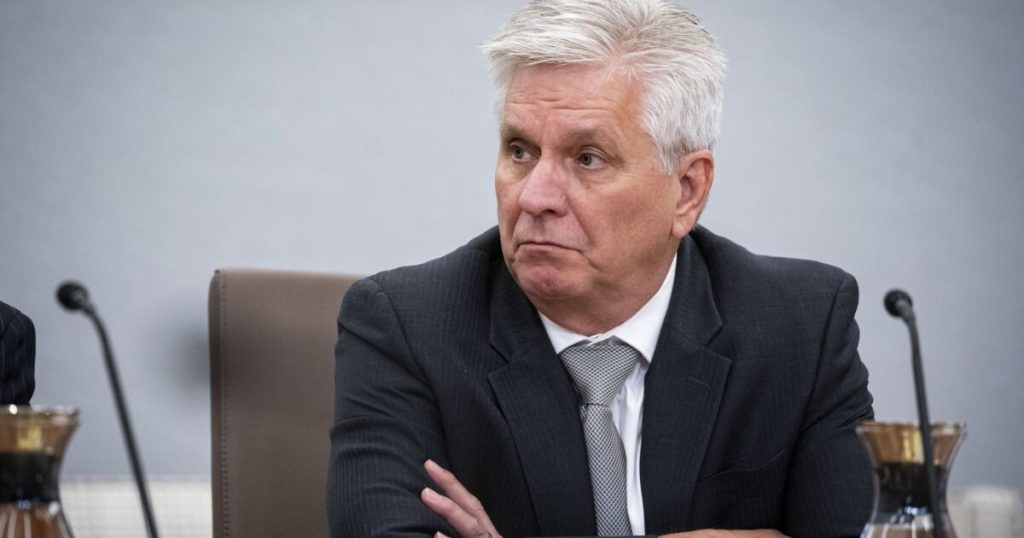
- Key Insight: Federal Reserve Gov. Christopher Waller said fintechs want greater access to the Fed’s payment rails, while banks stress strict oversight and safeguards for nonbank account holders.
- Expert Quote: “You’re seeing one side pulling me this way and the other pulling me that way, so it’s finding the right kind of middle lane that I’m trying to get to with this ‘skinny’ account.” —Fed Gov. Christopher Waller
- What’s at stake: Waller said that despite the opposing views on how the payment accounts should be structured, the Fed still aims to finalize them by the end of 2026.
Federal Reserve Gov. Christopher Waller said the Fed’s efforts to create “skinny” master accounts have sparked sharp divisions within the financial industry.
Processing Content
Speaking Monday at a Global Interdependence Center summit in La Jolla, California, Waller said feedback from banks and nonbank financial firms has highlighted sharply different priorities between the two groups. Commentary on the narrow payment accounts was due Friday, Feb. 6.
Waller, who chairs the Fed’s committee on payments, clearing and settlement, said feedback from the request for information, or RFI, shows that nonbank and crypto-focused firms want access to more Fed services, while banks want stricter guardrails around these companies.
“Everyone is yelling at me, they just did it on Friday,” Waller said. “On the one hand, crypto-focused institutions want more stuff. They want interest on the account, or they want ACH, even though that puts credit risk on us. They want access to those payment rails, not just Fedwire and FedNow.
“Then the banks are looking at this in a very different way. Most of their comments are on money laundering and illicit finance. Do [fintechs] have the controls for fraud, tax evasion? Do they have the same kind of controls we have? These are fair questions on both sides.”
Commentary from crypto and fintech representatives highlighted limitations in the proposed plan, with both groups saying the current framework would leave them largely dependent on bank intermediaries.
Nonbank firms are seeking broader access to the Fed’s payment rails, including the automated clearinghouse, or ACH, which handles payroll, bill payments and direct deposits. They are also pushing to change the suggested overnight balance limit, which currently caps firms at the lesser of $500 million or 10% of total assets, and want the Fed to consider letting holders of these accounts to eventually become master account holders.
Meanwhile, bank trade groups, including the American Bankers Association and the
The BPI proposed that nonbanks demonstrate “successful safe and sound operation for a minimum of 12 months prior to being permitted to apply for a payment account.” The bank trade groups also suggested that payment account applications be published for public comment by the reserve banks.
Both the ABA and BPI supported the Fed’s decision not to grant skinny account holders access to ACH, the discount window, or Fedwire Securities (Transfer Against Payments), a stance opposed by fintech and crypto firms.
The two trade groups also supported an overnight balance cap on payment accounts but urged the Fed to consider an activity-based formula rather than one tied to total assets, noting that such an approach could help maintain liquidity and reduce risk.
“You’re seeing one side pulling me this way and the other pulling me that way, so it’s finding the right kind of middle lane that I’m trying to get to with this ‘skinny’ account,” Waller said.
Waller said the Fed plans to finalize the payment
The
To reduce credit risk to reserve banks, skinny account holders would not earn interest on balances, nor would they have access to the Fed’s discount window. Waller said the accounts could spur innovation in the payments space while balancing the Fed’s risk exposure.