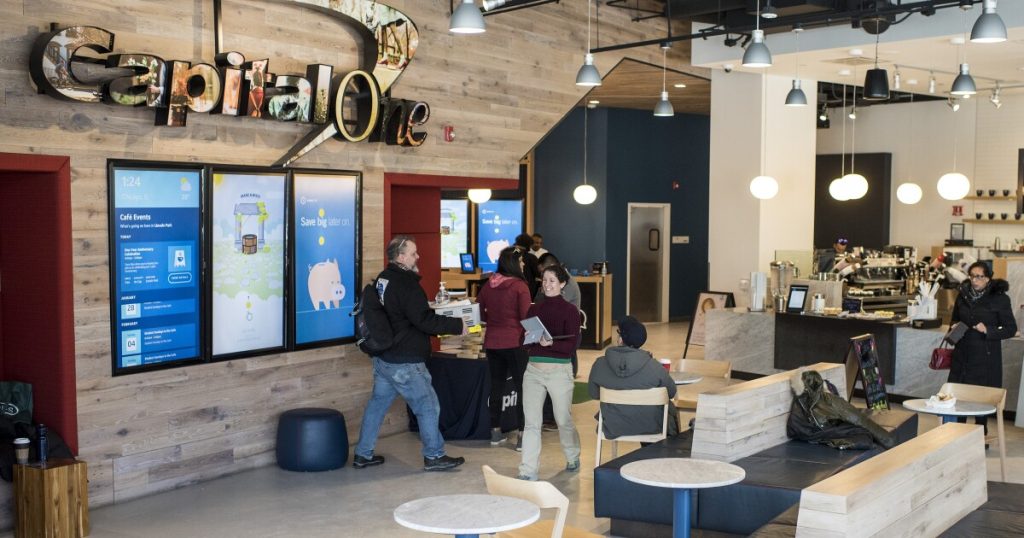
- Key Insight: Banks across the U.S. are repurposing their buildings as everything from cafés to community rooms. Critics say some examples are against the law.
- Supporting Data: Capital One already operates 65 bank cafés, and is planning more for 2026.
- Expert Quote: “This practice violates the law that separates banking from commerce and is the kind of unfair competition that antitrust laws were meant to stop,” the nonprofit Americans for Financial Reform has said.
Processing Content
As banking continues to move online, and
Capital One Financial is the most prominent operator of
In upstate New York, Five Star Bank has set up WeWork-type spaces where nonprofits can hold meetings. In Oklahoma, Citizens Bank of Edmond has opened its main branch as a “Community Lobby,” hosting events from photos with Santa Claus to Pokémon Go tournaments.
In many cases, the public can enjoy these spaces for free. But the banks still benefit, marketing experts say, by attracting new customers, rewarding existing ones and creating a positive, inviting on-ramp to more substantial banking services.
“People don’t walk into a bank normally feeling super relaxed, but they walk into a cafe feeling that way,” Erinn Steffen, chief operating officer of the marketing agency Mower, said in an interview. “And that matters, because when people feel comfortable, they’re much more open to learning.”
Capital One opened its first café in 2014, two years after it acquired ING Direct. The cafés function as storefronts for Capital One’s digital bank, which grew out of that merger. Inside each café, members of the public can buy coffee, use ATMs and, if they’d like, talk to one of the tablet-wielding Capital One representatives about banking products. Today there are 65 Capital One Cafés across the U.S., with more planned for 2026.
This innovation is not without controversy. Consumer advocates have complained that the cafés cross the line from banking into commerce, which is illegal for banks to engage in, and create unfair competition for local coffee shops. One nonprofit group, Americans for Financial Reform, has
“This practice violates the law that separates banking from commerce and is the kind of unfair competition that antitrust laws were meant to stop,” Americans for Financial Reform wrote in an email to supporters. “Banks are not permitted to own or subsidize commercial businesses, and Capital One is doing both.”
Bloomberg
For its part, Capital One says there’s nothing illegal about the cafés. They are not bank branches, the lender told American Banker — though ATMs are there, actual bankers are not — and the coffee is sold not by the bank, but by a third-party vendor called Verve Coffee Roasters.
“This model was vetted by our regulators as part of our 2012 acquisition of ING Direct, and fully complies with all regulatory requirements,” Jennifer Windbeck, Capital One’s head of retail bank operations, said in an email.
The controversy shows one of the risks involved in this strategy. While there can be benefits to repurposing office space, the banks that do so must walk a fine legal and ethical line.
“Banks like Capital One are really careful to position their cafés as engagement environments, not commercial businesses,” Steffen said. “As they navigate that tricky situation, it’s got to be really clear that they don’t exist to sell the coffee.”
This complexity hasn’t stopped other lenders from using their branches in novel ways. In Western and Central New York, Five Star Bank has opened up meeting rooms for nonprofit organizations to use. The rooms include high-speed Wi-Fi, high-definition screens, phones for conference calls and other features — all available for free.
“Our community rooms represent one of the ways we’re reimagining how bank branches can serve as community hubs,” Eric Marks, Five Star’s chief consumer banking officer, said in an email.
Meanwhile, Citizens Bank of Edmond has embraced not just one repurposing of its physical spaces, but three:
The Community Lobby, open 24/7 at the bank’s headquarters, hosts local events from Mahjong Moms to homeowner association meetings.
Why share all this valuable office space? Citizens’ CEO Jill Castilla says both the bank and the community benefit in the long run.
“We want to make sure we’re being a modern, relevant community bank but also being one that’s deeply entrenched in its community,” Castilla told American Banker. “And the best way, especially on the business banking side, is to be there at the beginning with a small business.”
Not all these services are free to community members, but they’re close. Citizens RISE charges $50 per month, or $25 per tenant if two businesses share the same storefront. And Vault 405 does charge customers, though at a lower rate than other coworking spaces, Castilla said.
The coffee, however, is free.
“We’re not selling our coffee,” Castilla said. “We always have our coffee machine accessible to [customers]. We see that as part of welcoming someone into our institution.”