Key Takeaways:
Processing Content
- The success of the TradFi-DeFi convergence depends on the interoperability of the payment infrastructure to prevent market fragmentation.
- The “on-chain” economy still needs the stability of traditional settlement. Decentralized technology and traditional banking oversight are becoming increasingly interdependent.
- Enablement of on-chain tech will require financial institutions to identify specific market segments that align with their business model and client base.
We have entered an era where regulatory clarity and institutional capital are forcing a convergence of TradFi and DeFi, creating a high-stakes race to build the next generation of global payment infrastructure.
Different from previous cycles, the current convergence of TradFi and DeFi is being driven by
This convergence has been top of mind since I stepped into my role as American Banker’s first Payments Intelligence Analyst. It also emerged as a key discussion topic among banking and fintech leaders at American Banker’s recent
At the summit, it became clear that large-cap banks are operating their own on-chain technology and believe that it’s no longer if these worlds will collide, but how the plumbing will hold up when they do.
It begs the question: How does the rest of the industry adopt this new plumbing without breaking the systems customers already trust?
In my five years at the Federal Reserve before joining American Banker, my focus was primarily “under the hood”—analyzing the often invisible infrastructure that determines the settlement and reconciliation of a payment. I researched how emerging entrants, from
As we further introduce blockchain into this mix, the fundamental question becomes: Does this technology solve efficiency problems, or does it just build a new set of walled gardens?
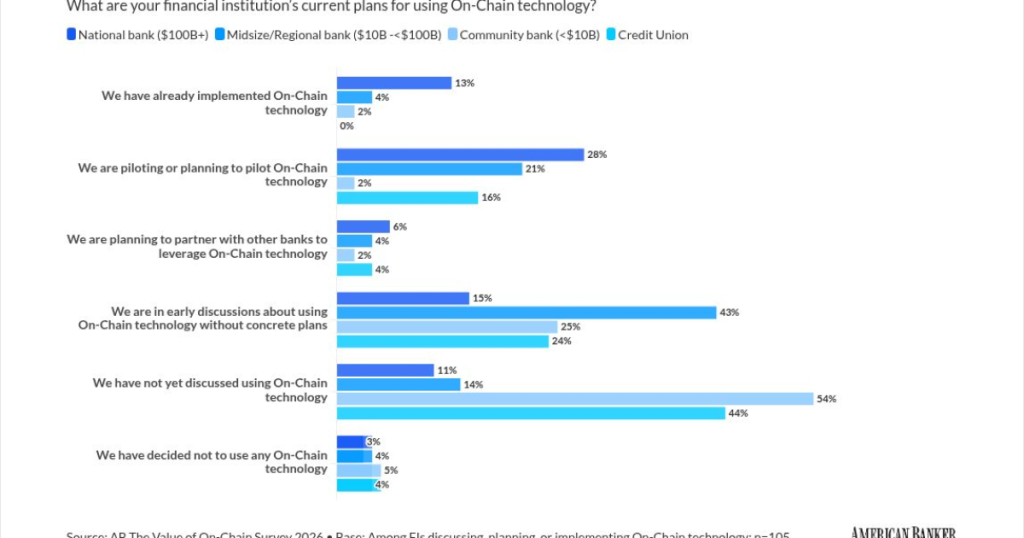
Despite the high-level buzz, a recent
Most banks have not yet begun formal discussions or are in very early discussions around on-chain technology enablement, especially for midsized/regional banks, community banks, and credit unions.
Pragmatically, this makes sense. Few community bank and credit union customers are walking into branches asking for stablecoins or on-chain tech, and many mid-sized/regional banks may lack the R&D budget or executive buy-in to launch pilots that may never scale. This contrasts with the many recent headlines announcing stablecoin or deposit token issuance plans of large fintechs and institutions. Some firms are taking a more aggressive approach to on-chain launch initiatives.
National/large banks are doing more planning, pilots and deployments of on-chain tech. Large banks have developed their own stablecoin to allow for institutional investing and trading (i.e., JP MorganChase), they’ve launched crypto custody services for institutional clients (i.e., Citi, BNY), and we’ve seen growth in yield-bearing on-chain funds through tokenized deposits, treasuries and money market funds.
National banks can leverage their capital to lead the charge, while smaller institutions may be left wondering which “lane” to pick. While the headlines are often brimming with new successes or initiatives, the survey data shows that for many of the over 11,000 financial institutions in the U.S., integrating or enabling on-chain technology is difficult. Doing so requires a shift from theoretical discussion to the practical, risky reality of on-chain technology adoption.
For a regional bank, the choice is confusing: Which stablecoin will my merchants actually use? How do I enable an endless number of tokens without skyrocketing my risk profile?
Navigating this risky reality requires a clear understanding of why a bank is adopting the technology in the first place. While large banks have the capital to experiment across all fronts, the path forward for the rest of the industry depends on moving past general buzzwords to identify specific, high-impact applications. Is it tokenized deposits, stablecoins for cross-border payments, or programmability? There is a lack of consensus on where the technology provides the most immediate ROI. The American Banker survey also reveals some of this fragmentation, showing a broad spread of perceived value, and reveals a diverse range of use cases. These include payments and settlement efficiency, cost reduction and back-office automation, to name a few.
For on-chain tech to be of benefit, it must solve specific problems, and that depends on institutions and businesses. While the survey results show a broad spread of perceived long-term benefits of on-chain tech, it varies by institution size. Banks of all sizes see payments and settlement efficiency as the use case that would provide the most value. Bankers at midsized/regional institutions perceive efficiency and client retention/acquisition as the two top generators of value, at 70% each. Both national banks and community banks see long-term benefit across all use cases, but community banks have lower expectations for deriving value from any use of on-chain technology.
While these survey results look long-term, enabling on-chain tech might serve a bank or business in a more immediate way, whether it’s through back-office automation or supporting custody of assets. It may be that the programmability of money to ensure a payment triggers only when a specific condition is met is more important than having faster payments. The decentralized smart contracts handle the logic, but centralized finance provides the trusted banking services.
For midsize and small banks, specific use cases may best determine how they first enable on-chain, and right now, there is no one-size fits all. Because most U.S. consumers are not using stablecoins for payments, midsize, regional or smaller institutions may find opportunity in utilizing consortiums for on-chain education and adoption, and to compete with larger banks (i.e. USDF Consortium, Cari Network). Doing so supports smaller budgets, while also limiting risk, and allows banks to dip their toes into deposit tokenization and other on-chain tech.
A clear set of on-chain tech use cases exist for institutional investors, whether through 24/7 global trading, tokenized assets or programmable smart contracts. But recent regulatory changes further bring into question how these use cases will expand, and how incumbent DeFi firms can further capture market share or develop within the payments ecosystem. Despite the hype, there are a lot of financial institutions still “waiting and seeing,” and those that can identify their specific on-chain ROI, whether that’s back-office automation or expanding their deposit capabilities, will be able to build the reliable links between legacy trust and digital efficiency. While a total convergence of TradFi and DeFi remains a work in progress, the institutions that prioritize interoperable, reliable infrastructure today will be the ones defining the standards of global value transfer tomorrow.
The winners won’t just be the most innovative, they will be the ones who build the most reliable connective tissue between the legacy systems we trust and on-chain technology that aims to address long-standing inefficiencies.