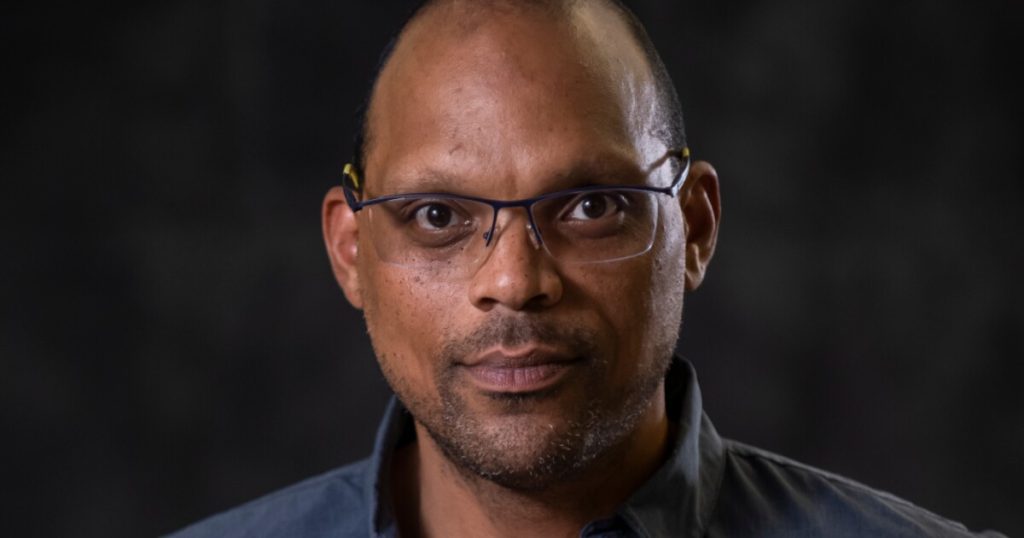
Five years ago, Brian Peret was an inmate in a Florida prison. Today, he is the director at CodeBoxx Academy, a place where people gain the skills they need to obtain AI jobs, at banks and elsewhere.
Codeboxx Academy, an accredited institution based in St. Petersburg, Florida, is not a traditional school: there are no lectures, papers or even teachers. It uses a business simulation to instruct students and build coding and AI skills. People come Monday through Friday, 9 a.m. to 5 p.m., for four months and work in a simulated job. Graduates receive a diploma in software development.
“I can teach you how to communicate with AI,” Peret said. “I can teach you how to develop and how to code. Those are the things that are most important. And with the power of AI tools, it has democratized development like never before.”
Peret spent two years in a Florida prison, where he began developing his coding skills. After his release, he not only kept working on his skills but worked at helping others also develop new skills and find their way into jobs they may not have thought were attainable. One thing Peret has realized, he said, is that value exists everywhere. “I’ve been in boardrooms, I’ve been in labs, I’ve been in the hood, and I’ve been in prison,” he said. “And I can tell you, there’s not a whole lot that separates us.”
That insight applies to banking. Programs like Peret’s are filling a void for banks that struggle to recruit and hire people with advanced AI skills. Big banks such as JPMorgan and Capital One
“There’s definitely a demand for such initiatives,” Ryan Hildebrand, chief innovation officer at Bankwell, a $3.2 billion-assets bank based in New Canaan, Connecticut, which has no affiliation with the program. “As we continue to implement more AI at the bank, we’re always on the lookout for talent proficient in these tools. Applicants who have participated in programs like the AI Academy at Codeboxx would certainly be viewed as having a valuable asset when applying for positions.”
The AI skills gap is real, said John K. Thompson, CEO and managing principal of The World of Analytics, a consulting firm, and adjunct professor at the University of Michigan. Thompson formerly was global AI leader at EY and has written several books on AI.
“Even with the advancements in AI’s ability to generate code, images, text and video, we still have a yawning gap between the need for people to fill jobs and the number of qualified people to do so,” Thompson told American Banker. “It is clear that there is confusion about early career hiring and AI. Many people are confused about who to hire and when to augment staff members of all levels with AI tools.” There is a burgeoning need for the types of skills development and certificates offered by Codeboxx and other programs, he said.
Among banks that are not using AI, the number-one challenge to AI adoption is “low levels of data literacy or technical skills,” according to a recent Gartner survey. Among banks that are using AI, it’s the second greatest challenge.
To be sure, many educational programs exist for professionals who want or need to develop AI skills. New York University, Harvard, MIT, Columbia University, Purdue University and the University of Michigan are among the colleges that offer AI classes and certificates. Codeboox Academy is unusual in that it simulates a full-time job and its director is an ex-con.
From prison to AI mentor
Peret grew up in a low-income neighborhood in Milwaukee, Wisconsin, with a single, alcoholic parent. Through scholarships, he got a bachelor’s degree in chemical engineering and a master’s degree in biomedical engineering at the University of Wisconsin in Madison.
After graduate school, he moved to St. Petersburg, Florida in 2008, just as the financial crisis hit.
“All of a sudden I’m in the job market with people who’ve been working 10 years in the industry, and here I am with a master’s degree and no industry experience beyond that,” Peret said.
He was never given any training on how to obtain a job once he left college, he said.
“I was trained on how to be an elite thinker in my field,” Peret said. “But when it came time to create a career, my university education was not there for me. I went back to the things that I knew.”
Peret had had a part-time job as a cook when he was in high school. In St. Petersburg, he found work as a cook and as a bouncer.
“I got back into the kitchen and I got into a lifestyle that was unhealthy,” Peret said.
He formed a drinking habit and accidentally hit someone with a car while under the influence. (The victim didn’t die, but her arm was injured.) He was sentenced to five years and ended up doing 20 months when he won an appeal. In two of the four Florida jails he was put in, he was in maximum security.
“It was interesting, because you’d watch the news, see somebody commit this heinous act, and then in 24 hours, they’re sitting right next to you,” Peret recalled.
Yet his time behind bars gave him an opportunity to get sober. While in prison, he took a computer programming class. His brother helped him get contract work as a developer.
“I was looking at some of the other people in this computer class, who were developing programs that the Department of Corrections used for their payroll,” Peret said. “I thought to myself, some of these guys are never going to get a chance to use the skill set. On the outside, nobody’s going to give them a chance to use this skill set. Or if they do, they’re going to be discounted.”
Peret also participated in the prisons’ faith-based programs and read the Bible twice, cover to cover. “I did some preaching, I got to know the chaplains,” he said. “I got involved in Toastmasters, which is a program I’m still involved in today to the point where I’m a
He rebuilt a prison camp’s GED program, taking Florida’s GED requirements, creating a curriculum, identifying teachers, finding all the prisoners who needed a GED and scheduling classes for them.
Once he was released in 2020, Peret wanted to continue developing software and help other incarcerated people to get this kind of work. The skills he developed in prison “very much apply to the modern day tech workforce, which is intense, which is uncertain, which requires you to be new at something every day,” Peret told American Banker.
Codeboxx, a formerly Quebec-based software design studio, moved its headquarters to St. Petersburg in 2022 and recruited Peret.
This was unusual. Typically it’s very
“One of the most attractive things about a career in tech is you can work in it as somebody with a record,” Peret said. “We had a senior vice president in charge of AI architecture for a major technology corporation come in yesterday and interview six of our graduates, one of whom is quite upfront about the time he spent in prison. And rather than knocking him for it, he very much sees the virtue in it. He appreciates how this individual can communicate vulnerability.”
This isn’t universally true, Peret explained. In health tech, defense tech or companies whose HR departments have rigid policies, it’s still hard for anyone with a past felony to get hired.
Developing an AI curriculum
Codeboxx hired Peret to be a coach at its academy, to help teach engineering and developer best practices. He was quickly promoted to program director and overhauled the Codeboxx Academy curriculum to reflect the ongoing nature of innovation in the tech world.
In late November 2022, the week OpenAI made ChatGPT public, Codeboxx Academy started to see students using it on their projects, Peret said.
“Like anybody who uses a powerful tool without training, there’s going to be ups and downs, and the more powerful the tool, the farther down the downs can be,” Peret said. “Our students were using it very much to their own detriment. Our coaches were having to come in and undo all kinds of stuff.”
So Peret and the team pivoted the curriculum to focus on best practices for using and developing AI models.
“We see there are AI native bankers and AI native teachers and AI native journalists,” Peret said. “What does it mean to be AI native, and what are the philosophies that define being AI native? That’s what we’ve really done over here at Codeboxx over the past year.”
Codeboxx Academy has campuses in St. Petersburg and in Montreal. In St. Petersburg, the Academy has space in the ARK Innovation Center, which is spearheaded by investor Cathie Wood. There’s classroom space and a tech accelerator where students get access to startups and thought leaders.
People from all walks of life are welcome. “I look at my neighborhoods and my communities, and I see so many uncut gems,” Peret said. “While I can’t give anybody a cheap house or access to funds, I can help my neighbor get a high-paying job, and I can help companies get skilled labor, and it just so happens those needs intermesh.”
In St. Petersburg, for instance, a person has to make at least $94,000 a year to live comfortably, he said.
“You’re not getting that in most sectors, but the average tech worker makes six figures,” Peret said. “I have a fundamental belief that if you work 40 hours a week in this country, you should make enough money to support yourself. Currently, the only place I see that consistently happening is in tech.”