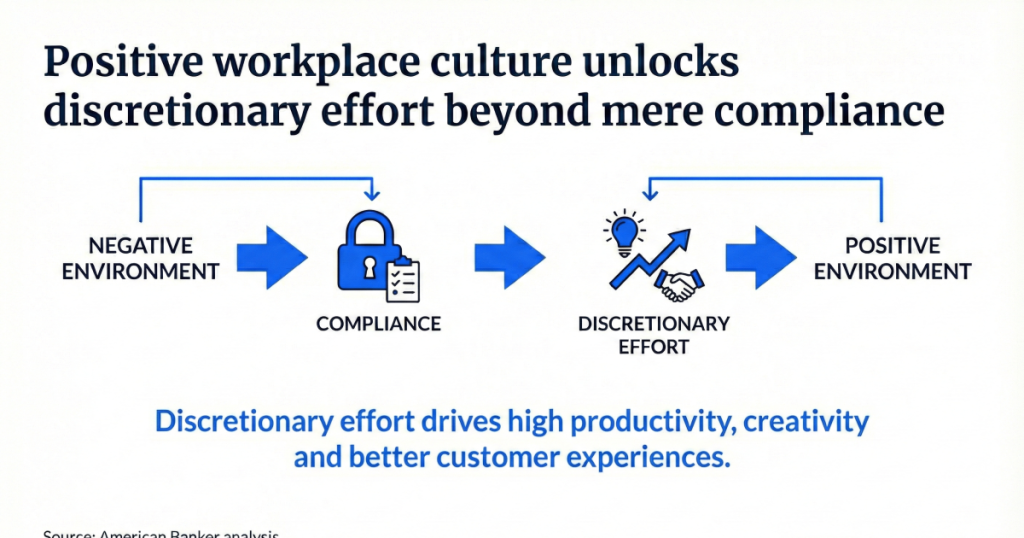
Visualization created with AI assistance based on original reporting.
Processing Content
- Key insight: A bank branch with a negative work environment will see less “discretionary effort” by employees
- What’s at stake: Disgruntled employees may comply with all workplace rules and requirements, but they are far less likely to put in the kind of extra work that makes the customer experience truly exceptional
- Forward look: Bank managers need to correct open negativity quickly and privately, model the tone they want to see from their employees and call out extra effort when they see it
An experience on President’s Day had me shaking my head and joking with my wife, and reminded me of some very real challenges
We were about two hours into a six-hour drive home when I decided to stop at a store we had been to many times before.
This one has a national chain sandwich shop inside and is connected to a “casino.”
We have never partaken of either the sandwiches or the gambling, but we had always assumed the extra amenities might prompt them to keep the place a little cleaner.
We found no evidence to support that assumption on this trip, but that’s what you get when you roll the dice on Louisiana I-10 gas station-truck stop-casino establishments.
What I found particularly noticeable, to the point of being sadly comic, was the ongoing public complaint session among the three employees while we were there. Their ability to move seamlessly from one loud grievance to another was impressive.
In the span of a few minutes, they covered everything from rescheduled Mardi Gras parades to the banks being closed to the mail not running to their manager being paid too much for how little she works. It was a master class in sustained dissatisfaction.
Now, one employee was sweeping while complaining, and another was pulling on rubber gloves to empty the garbage cans. So, they were working. But they were absolutely going to complain about anything and everything while they did.
The third person, our cashier, seemed to devote about 90% of her attention to the ongoing gripe session with her co-workers and maybe 10% to ringing us up.
She did not thank us, but she did pause her griping for two seconds to mutter, “No problem,” without looking in my direction, when I thanked her.
As we got back in the car, I told my wife I felt like I had just worked a shift at that store.
After only a few minutes inside, I was ready for a nap.
She smiled, agreed, and said she felt a little drained and mentally tired herself from the misery theater we had just witnessed.
That said, I completely understand and even empathize with people who are not exactly feeling it at some jobs or on certain days. I was not always the ambassador of jovialness when I was cleaning floors and equipment at a grocery store back in the day.
But I have observed equally toxic environments in workplaces filled with well-dressed folks, making a lot more money, in jobs that required far less sweeping and garbage handling.
Conversely, I have also worked some pretty unglamorous jobs in the past alongside people who brought smiles and laughter to even the dirtiest of dirty tasks. The same has been true in some of the more stressful and cutthroat environments I’ve found myself in along my winding career journey.
This recent experience reminded me of the hundreds of times I have talked about the impact of our brain’s open loop limbic system. As humans, we are wired to be affected by our environments and by the moods and demeanors of those around us.
Neuroscientists often describe this as emotional contagion, the idea that our limbic systems help sync us up with the emotional states of others. In other words, feelings are contagious.
I have long suggested that the saying “Misery loves company” might be more accurately stated as “Misery creates company.” It does not seek it out. It manufactures it.
However, good humor creates company, too. It spreads. Not always as quickly as misery, especially in difficult moments, but even one good attitude can be a force multiplier in a workplace.
I have encountered more than a few managers over the years who dismiss talk about the importance of a positive workplace as, well … sappy. I mean, hey, grow up. You are paid to do a job whether you are enjoying yourself or not.
Customers do not care if you are having a bad day as long as you give them what they want. Right?
Not so fast. You can get compliance in negative environments. You will not get discretionary effort. And discretionary effort is what drives high productivity, creativity and better customer experiences.
And in a banking world where
Good humor and respectful work environments lower stress, strengthen teamwork and fuel engagement. All three tend to improve performance and even boost employee retention. And decades of research show that when employees stay longer, customers are far more likely to stay, too.
Leaders cannot mandate happiness, but they can shape atmosphere. That means correcting open negativity quickly and privately, modeling the tone you expect in public, and calling out and praising visible good humor when you see it.
You cannot control every emotion in a workplace. Nor should you try. But you can influence what is voiced, what is modeled and what is tolerated.
Words turn into attitudes. Attitudes turn into actions. And actions turn into your culture.