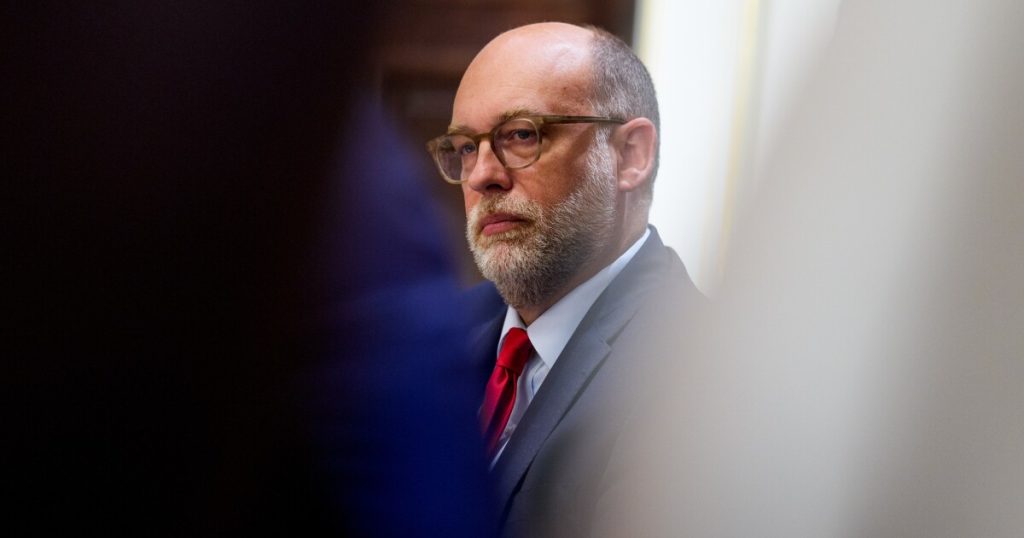
- Key Insight: Acting Consumer Financial Protection Bureau Director Russell Vought claims the CFPB will run out of money in early January, an issue that may be moot if the Federal Reserve System returns to profitability.
- Supporting Data: The Trump administration’s strategy of eliminating the bureau is at odds with the agency’s aggressive regulatory agenda.
- Expert Quote: “I think that you’re seeing a hollowing out of the CFPB,” said one banking expert. “But the shell remains.”
The Consumer Financial Protection Bureau is hanging by a thread, with the bureau’s continued existence being called into question in three separate legal cases that could take up to six months to play out.
Acting CFPB Director Russell Vought and President Trump have made
Processing Content
Last week, the CFPB’s roughly 1,400 employees
Vought claims he has the authority to fire staff. For now, Vought has been prohibited by a temporary injunction from issuing a reduction in force at the agency.
Even as the CFPB’s union fights for the agency’s survival, many banking and legal experts question
Norbert Michel, vice president and director at the Cato Institute’s Center for Monetary and Financial Alternatives, said he doesn’t support many of the CFPB’s rules and regulations or the Dodd-Frank Act that created the bureau. Even so, he questioned the wisdom of the Trump administration’s legal strategy.
“I don’t see any legal path for truly shutting the CFPB down — that has to come from Congress, and that’s just not happening,” Michel said. “I really don’t see how they do anything like transfer the authority or shut it down, I don’t see how that stands up. You can’t just decide to shut the judicial system down. It doesn’t work like that.”
In its brief 15-year existence, the CFPB has survived two Supreme Court challenges and roughly 100 attempts by lawmakers to change the agency’s structure and funding. This year, Republicans slashed the maximum amount the bureau can request from the Federal Reserve to fund its operations, with the maximum requested draw dropping from $785 million in fiscal year 2024 to $446 million in fiscal 2025, according to the
Last month, Vought
In response, the NTEU went
The CFPB is at a critical juncture, said Mike G. Silver, a partner at the law firm Spencer Fane.
In the short-term, it appears that it will take a court order or a response from the Federal Reserve saying they have sufficient “combined earnings,” for Vought to relent on current efforts to wind down the bureau based on the funding issue.
“They’ve left some wiggle room, strategically, for determining when the funds from the Fed are exhausted,” said Silver, a former longtime CFPB senior counsel in the Office of Regulations.
Longer-term, he sees the litigation taking four to six months to come to some resolution.
“They’re at a fork in the road, and
The CFPB has put forth
“It seems like all year they’ve been trying to have their cake and eat it too, in terms of taking all these steps to undermine the structure of the agency and their operations day-to-day, while at the same time promising a very ambitious policy agenda where you actually need live humans who are experts to write those rules, that in many cases will benefit industry stakeholders based on their current posture,” Silver said. “Those things seem fundamentally at odds with one another.”
Since Vought’s main job is director of the Office of Management and Budget, some bank experts say he is using employees on detail from OMB and political appointees to write some CFPB’s rules along with agency staff.
Other experts and consumer advocates point to the long list of legal requirements in Dodd-Frank, including the requirement to conduct periodic examinations of nonbanks, as proof that Vought is not fulfilling the bureau’s statutory mandates. Banking experts are privately cheering that there will be little to no supervision or enforcement of financial firms for the next three years, with examinations primarily conducted by prudential regulators.
“The market can and will disagree on policy choices. But having experts on staff, with an in-depth understanding of the history behind the agency’s rules and capacity to analyze feedback, is important to balance competing interests,” said Adam Maarec, a regulatory attorney at the law firm McGlinchey Stafford. “The agency is sending mixed messages. The acting director says he wants to shut the agency down and has dramatically reduced its headcount, but at the same time, the agency has one of the largest rulemaking agendas in its history.”
Banks are increasingly concerned about the lack of oversight of fintechs at a critical time when the CFPB is
Maarec said he doesn’t know how the CFPB will read the
“Hastily drafted revised rules aren’t likely to satisfy the market and could risk continued litigation,” he said. “I can help summarize those comments, but considering the facts and arguments they made, the world of possible alternatives, and the impact of those alternatives takes time, expertise, and analytical rigor.”
Earlier this month, three nonprofits — Rise Economy, Woodstock Institute and the National Community Reinvestment Coalition — sued Vought in his capacity as acting director for refusing to request funding for the CFPB. The
Banks and their trade groups have long called for a CFPB reboot due to the
Yet many legal experts say that Vought is required by law to perform certain duties that he isn’t performing.
Steve Ornstein, a partner at Alston & Bird, who co-leads the firm’s consumer financial services team, said many in the financial services industry want effective regulators to handle new products and technologies like AI and crypto.
“These industries at some level need to be regulated,” said Ornstein.