Mortgage rates have been surprisingly resilient lately, despite all the inflation concerns related to the ongoing conflict in the Middle East.
At last glance, the price of a barrel of oil was over $110, up from the $60 range in February.
Yes, mortgage rates have risen quite a bit since that time, but they remain only about a half point higher.
And it’s important to remember that mortgage rates were at 3.5-year lows at the end of February.
So bouncing off those levels isn’t as bad as it appears. The question is does it get worse again before it gets even better?
Mortgage Rates Fell Nearly 0.25% Last Week
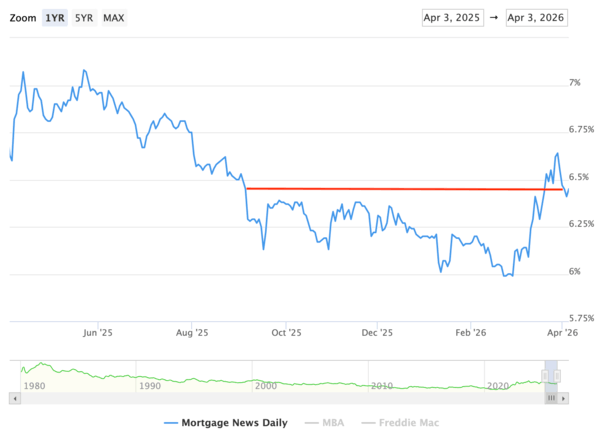
Mortgage rates actually had a winning week, falling about 20 basis points from the end of March to last Friday, per MND.
They had risen as high as 6.625% for a 30-year fixed before dropping to around 6.45% to close out the week.
While it’s still well above the 5.99% rate briefly hit in late February, it’s not far off and it beats going even higher.
Many, including myself, expected the 30-year fixed to climb to 6.75% and perhaps 6.875% in the near-term.
We somehow eked out a win in the midst of a seemingly unprecedented conflict in Iran, which has caused oil prices to just about double.
That has many economists worried about a second wave of inflation, overriding any benefit you’d normally see from a geopolitical event.
Typically, mortgage rates go down during wars or conflicts because there is typically a flight to safety in bonds, increasing demand and lowering associated yields (interest rates).
But this time it’s a little more complicated because global energy prices have surged due to the veritable closure of the Strait of Hormuz.
The Trend Is Not Mortgage Rates’ Friend
While we got a good week to start off April, something tells me things could still get worse before they get better.
Simply looking at the rhetoric from President Trump should make you worry that mortgage rates could be due for another jump higher.
On Easter, he used expletives in a Truth Social post demanding that Iran open the Strait of Hormuz or face its wrath, including destroying bridges and power plants.
Meanwhile, “Israel struck a key petrochemical plant in the massive South Pars natural gas field,” illustrating that any attempts at a ceasefire will be very difficult.
There have been efforts to establish a 45-day ceasefire, but there’s also a deadline of 8 p.m. EST Tuesday to carry out new attacks on Iranian infrastructure.
If the U.S. follows through, that would likely jeopardize any negotiations and lead to a response from Iran, further exacerbating the already dire situation.
As such, mortgage rates could suffer a second wave of increases after appearing to settle down in recent days.
Will Mortgage Rates Suffer Another Setback?
Since this conflict got underway, I’ve felt 30-year fixed mortgage rates would come close to 7% again.
If you’ve watched mortgage rates for any extended period of time, you know they don’t move in a straight line up or down.
Instead, they ebb and flow, often bouncing around, even if trending higher or lower over time.
Just look at their move from 7%+ to sub-6% over the past year. They didn’t just go down, down, down.
There were bad weeks and even bad months, but they still managed to improve over time once we zoomed out.
Similarly, this could be a situation where they worsen over time, despite having good days and good weeks here and there.
So while last week was encouraging for mortgage rates, it’d be foolish to think the worst is behind us here.
The best-case scenario is we get some sort of ceasefire or peace deal as soon as possible, and perhaps some movement in the Strait.
But one should also prepare for the worst, a ratcheting up of the situation that leads to even higher energy prices, an uptick in inflation, and another leg higher for mortgage rates.
How high they might go remains to be seen, but I wouldn’t completely rule out the very high 6s or even low 7s if things don’t get under control soon.

Before creating this site, I worked as an account executive for a wholesale mortgage lender in Los Angeles. My hands-on experience in the early 2000s inspired me to begin writing about mortgages 19 years ago to help prospective (and existing) home buyers better navigate the home loan process. Follow me on X for hot takes.