If it bleeds, it leads. Articles about data breaches, outages and fraud were among the best read American Banker stories this year. Readers also clicked on stories about the neobank Chime, Capital One and Navy Federal Credit Union.
Processing Content
Read on to see the ten most popular tech stories of the past 12 months:
Navy Federal offers members a debt-free path to credit
Navy Federal Credit Union announced in April that it would start letting members build their credit scores through rent and utility bills, thanks to the credit union’s work on consumer-permissioned data sharing.
Navy Federal offers members the ability to report recurring payments to credit bureaus. This can enable consumers to qualify for credit from lenders that accept the information.
The credit union partnered with Bloom Credit, a credit data infrastructure platform, to offer its consumer-permissioned data product Bloom+ to its 14 million members as a checking account feature in late March.
Read the full story
North Carolina credit union sues Fiserv over ‘insecure’ systems

Handout/PNC
Self-Help Credit Union recently filed a lawsuit against Fiserv alleging the tech giant knowingly provided insecure account processing systems and demanded “ransom” in the form of exorbitant termination fees when the credit union attempted to leave.
The complaint, filed Dec. 4 in the U.S. District Court for the Middle District of North Carolina, accuses Fiserv of failing to protect the credit union’s member data with the same safeguards it uses for its own corporate information — an alleged violation of the parties’ master agreement.
“Fiserv sold and operated systems that were so insecure that no regulated financial institution should have been asked to run its confidential data through them,” lawyers for Self-Help, based in Durham, North Carolina, wrote in the complaint.
Read the full story
Navy Federal, Truist, Chime among victims of AWS outage

In October, problems at Amazon Web Services’ northern Virginia data center caused outages and delays with web services across the internet, including at a handful of banks and credit unions.
The disruption served as a potent reminder of the financial sector’s dependence on centralized cloud infrastructure and contained echoes of widespread outages last year caused by a faulty update at cybersecurity vendor CrowdStrike.
Amazon Web Services, or AWS, provided frequent updates on its investigation into and recovery from the outage on a status webpage. The company made no indications about whether a cybersecurity incident caused the issues.
Read the full story
Feds still chasing billions in PPP fraud

More than four years after the Paycheck Protection Program, or PPP, stopped accepting applications, the U.S. federal government is still combating fraud that exploited the emergency fund disbursements, most recently securing a guilty plea by a co-founder of the fintech lender service provider Blueacorn.
The prosecutions are not likely to stop anytime soon. The statutes of limitations for various charges prosecutors use against PPP fraud schemes provides up to 10 years to open cases. Legislation passed in 2022 extended these timelines for PPP-specific charges.
This gives prosecutors until 2030 to 2031 to file charges, depending on when the particular fraudulent application was submitted.
Read the full story
Citi is rolling out agentic AI to its 40,000 developers

Mario Tama/Photographer: Mario Tama/Getty I
Citi has begun rolling out agentic artificial intelligence to its developers to automate simple tasks like software patches and upgrades. The bank formally announced the project during a July earnings call.
Agentic AI is a term for artificial intelligence systems capable of making autonomous decisions and taking actions with minimal human oversight. In this case, Citi has selected Cognition’s Devin agent.
This deployment comes amid steadily increasing adoption of advanced AI by banks, especially the largest ones. For instance, Goldman Sachs is testing the same Cognition AI agent for an expected rollout to its 12,000 human developers; it has also rolled out generative AI tools to its entire employee base. JPMorganChase has deployed generative AI to all its 240,000 employees.
Read the full story
Experian releases new score with credit and cash-flow data

Experian
Experian is consolidating its various forms of consumer credit risk data into a new single-score model for underwriters.
The credit reporting bureau now brings four types of consumer financial information — traditional credit, alternative credit, trended data and cash-flow data — into a single score called Experian Credit + Cashflow, available upon request to lenders.
The new type of score, announced in November, is Experian’s most advanced credit decisioning model, according to the company. It ranges from 300 to 850, mirroring the span of a traditional FICO score, and is currently available in an early access version for testing by interested lenders.
Read the full story
Neobank Chime debuts $500 instant loans for direct depositors
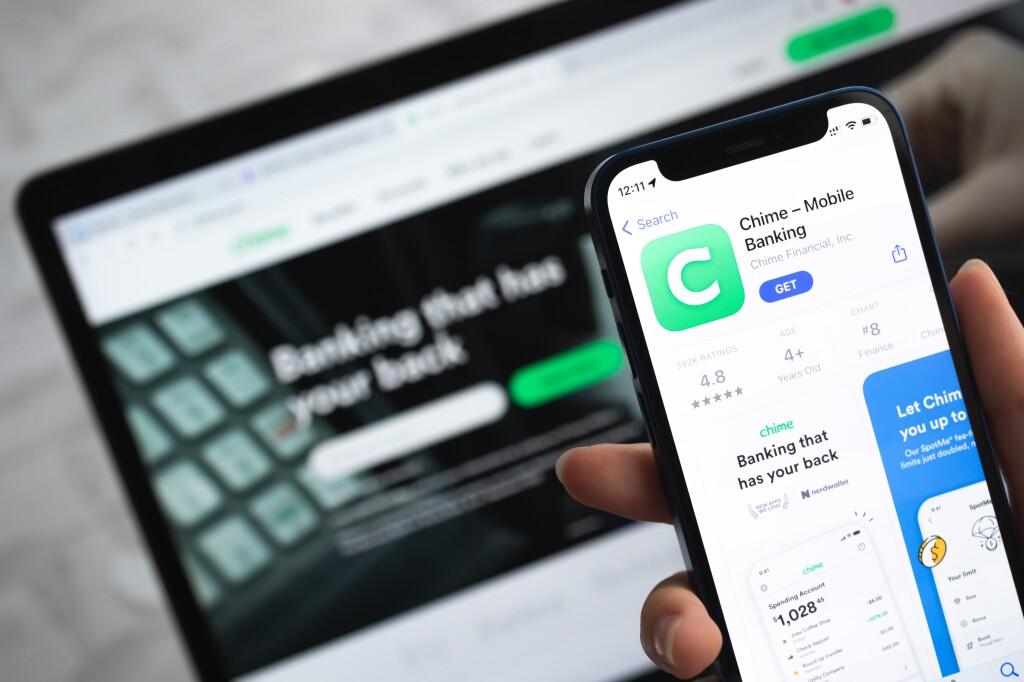
Neobank Chime will now offer what it calls “Instant Loans” — three-month installment loans of up to $500 at a fixed interest rate and without a credit check for members.
The fintech, which champions early paycheck access, will use its proprietary method to discern eligibility, relying on several factors aside from credit history to decide whether or not to lend. According to Chime, on-time loan repayments will help customers build a credit history.
Only Chime members who directly deposit their paychecks into their Chime accounts will be eligible for the new product. Chime members are notified via the Chime app if they qualify. If accepted, customers are given instant access to the funds.
Read the full story
Capital One’s five-day outage highlights third-party risk

In January, disruptions to financial transfers plagued dozens of banks, including Capital One, in an episode that highlighted the issues of technical resilience and third-party risks, two matters that regulators have given special attention in recent years.
Capital One and 26 other banks experienced outages that caused some deposits, payments and transfers to be delayed. Financial services vendor Fidelity Information Services, better known as FIS, said that a power outage initiated the disruption.
FIS provides banking operations and payments services to more than 5,800 companies and processed $12 trillion in 2023. A spokesperson for the fintech said the outage was “due to a local area power loss and a hardware failure.”
Read the full story
Chime secures new distribution channel with Workday partnership

Neobank Chime announced in August it would expand the reach of Chime Workplace, its suite of enterprise financial wellness solutions, with a new partnership with human resources and financial management platform Workday.
Chime Workplace is a set of financial tools and banking products, including earned wage access, checking and savings accounts and financial planning tools that employers can offer their employees at no cost. Employers can also set up loyalty and reward programs and see trends about their employees’ financial health, such as an active savings rate or the number of employees with direct deposit into a Chime account.
Chime will embed Chime Workplace directly into Workday’s Workday Wellness platform. Workday Wellness is an artificial intelligence-powered HR management tool for businesses that allows them to gain insights into which benefits their employees use.
Read the full story
The CFPB plans to kill the 1033 rule. Open banking lives on

If you asked the average person on the street if they would like their bank account data to be treated in the same way as data on Instagram or Facebook — that is, shared with advertisers, vendors and service providers — the response would be a resounding: “No! Absolutely not!”
Yet every day, millions of consumers give permission to a wide range of companies and digital apps that gather, analyze, store — and sell — the transaction data from their bank accounts.
Last year, the Consumer Financial Protection Bureau under the Biden administration finalized a rule requiring that banks share data, at a customer’s request, with another bank or authorized third party. The CFPB’s 1033 rule, known for its section in the Dodd-Frank Act of 2010, might have radically reshaped consumer finance and led to increased competition for banks. Now that the CFPB intends to set 1033 aside, it looks like banks and fintechs will continue to share data in the ad hoc way they have been for decades.
Read the full story