Bank executives were sent scrambling over the weekend after President Donald Trump declared late Friday that American credit card companies would be subject to a 10% cap on the interest rate they can charge customers.
The move sent shares of large banks including Citigroup, JPMorgan Chase, Wells Fargo and Bank of America down between 1% and 4% in early trading Monday. Companies more tightly tethered to the card industry, like Visa, Mastercard and American Express, also fell. Capital One, whose loan book is mostly from credit cards, sank nearly 7%.
Trump proposed a one-year cap on interest rates starting Jan. 20. While it’s unclear exactly how that would be enforced, the industry’s message is clear: the plan would bring unintended consequences for consumers and the American economy.
The move would make large swaths of the credit card industry unprofitable, especially tied to customers with less-than-ideal credit profiles, according to banks and analysts. The average credit card rate nationally is 19.7% as of this month, according to a weekly survey from Bankrate.com, while rates for subprime borrowers and store-specific cards are even higher.
Rather than offer loss-making products to consumers, the industry would simply stop offering access to customers with subprime credit, along with a slew of other changes around card programs including scaling back rewards, insiders say. Consumers would either spend less or rely on other forms of unsecured debt, many of which carry even higher interest rates than credit cards, they say.
“We cannot offer products at a loss; there’s no scenario where we would take our entire portfolio to 10%,” said a person with knowledge of the operations of a large bank, who asked to remain anonymous to speak candidly. “It’s not a stretch to suggest this will very quickly tank the economy.”
The drag on the economy from less spending could be more acute for airlines, retailers and restaurants, which would have to make up for lost card revenues by “potentially raising pricing” on their services, KBW analysts led by Sanjay Sakhrani and Chris McGratty said in a Jan. 11 research note.
The industry’s trade groups issued a joint statement late Friday making their case.
“Evidence shows that a 10% interest rate cap would reduce credit availability and be devastating for millions of American families and small business owners who rely on and value their credit cards, the very consumers this proposal intends to help,” the trade groups said.
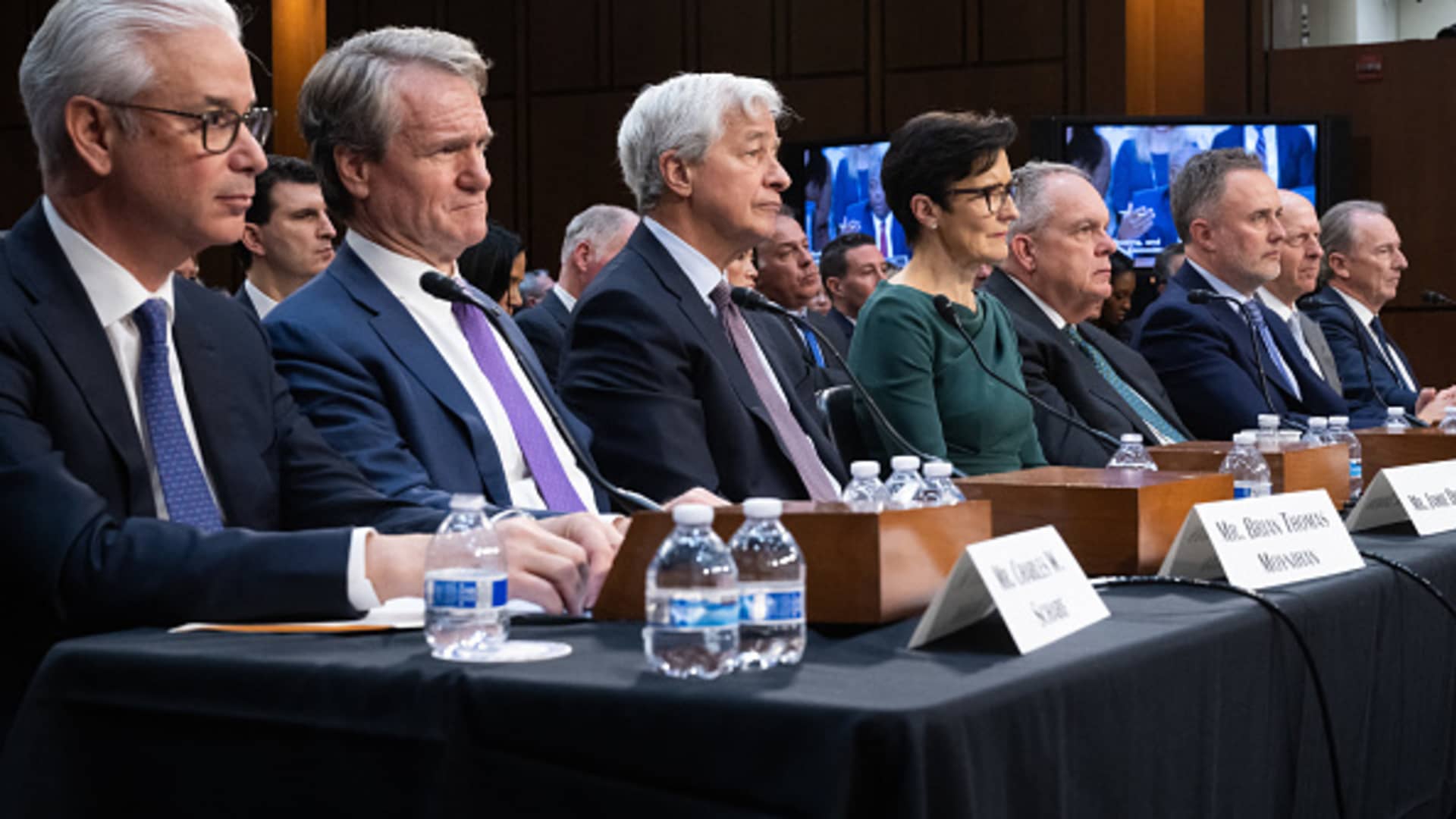
(L-R) Wells Fargo CEO and President Charles Scharf, Brian Bank of America Chairman and CEO Thomas Moynihan, JPMorgan Chase Chairman and CEO Jamie Dimon, Citigroup CEO Jane Fraser, State Street CEO Ronald OÕHanley, BNY Mellon CEO Robin Vince, Goldman Sachs CEO David Solomon and Morgan Stanley CEO James Gorman, testify during a Wall Street oversight hearing by the Senate Banking, Housing, and Urban Affairs committee on Capitol Hill in Washington, DC, December 6, 2023.
Saul Loeb | AFP | Getty Images
‘Opening bid?’
This isn’t the industry’s first time contending with possible price controls. A bill was introduced last year from Sen. Josh Hawley of Missouri and Sen. Bernie Sanders of Vermont that would limit card APRs at 10% for five years.
While that bill is stalled in Congress, a study looking at the Missouri market from the Electronic Payments Coalition found that a 10% cap on rates would mean that more than 80% of card accounts would lose access. Most accounts with credit scores below 740 would be shut, the study claimed.
Complicating matters, it is unclear to bankers how Trump’s rate cap would take place.
The most straightforward approach, through legislation in Congress, isn’t possible by the proposed Jan. 20 start date, said Tobin Marcus, head of U.S. policy at Wolfe Research.
Other enforcement means, through banking regulators including the Consumer Financial Protection Bureau, are also possible. But the Trump administration has repeatedly tried to shutter that agency, and the industry has had a successful run at defeating CFPB rules in federal courts.
“I’m not aware of an authority that they can use to do this unilaterally in any kind of a sweeping way,” Marcus said. “As far as I can tell, telling them they have until Jan. 20 is an attempt to create pressure and have them do it voluntarily.”
While the exact mechanism that Trump can use to enforce an interest rate cap is unclear, card issuers now face the risk that rates could be headed lower in some form of negotiated compromise with the government, KBW’s McGratty said in an interview.
“Is 10% an opening bid?” he said. “There’s a long distance between 10% and what companies charge today.”
Americans had a collective $1.23 trillion in credit card debt as of the third quarter last year, according to data from the Federal Reserve Bank of New York. Balances have been climbing as many Americans spent down the savings they’d built up during the global coronavirus pandemic.
Correction: This story has been updated to correct the spelling of Capital One.