- Key insight: The reclassification of marijuana means cannabis companies can enjoy significant tax-relief and better loans from banks.
- Supporting data: Schedule III drugs are considered medically viable, but are still federally restricted and require prescriptions.
- Forward look: The move by a Republican President to relax restrictions on the substance could build momentum for further banking reforms, particularly if Democrats re-take Congress.
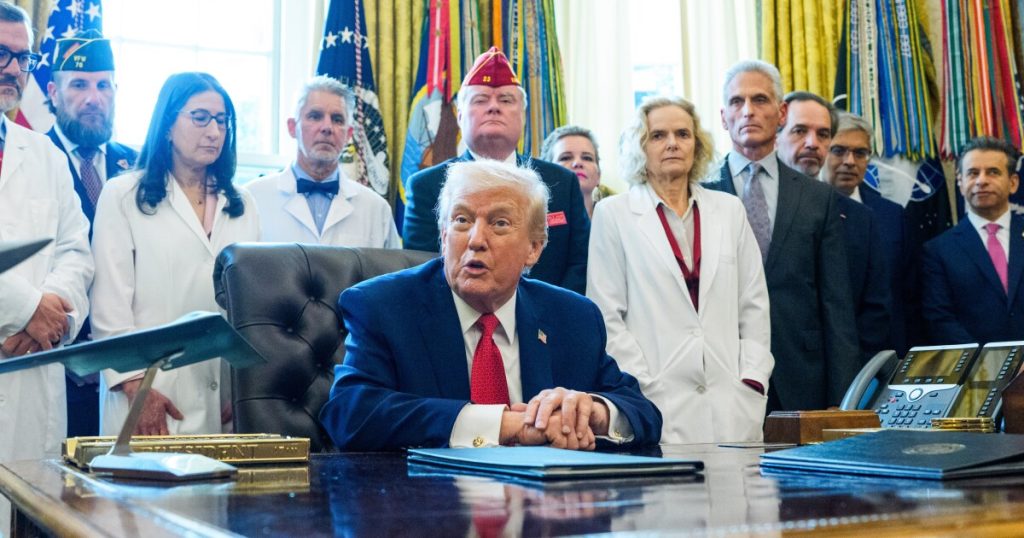
President Donald Trump on Thursday signed an executive order asking the Justice Department to fast-track a proposal to move marijuana to Schedule III from the most restrictive Schedule I, where it’s been for almost half a century.
Processing Content
The President framed the move as part of an initiative to help patients and facilitate the study of cannabis for medical research.
“This action has been requested by American patients suffering from extreme pain, incurable diseases, aggressive cancers, seizure disorders, neurological problems and more, including numerous veterans with service related injuries, and older Americans who live with chronic medical problems and severely degrade their quality of life,” Trump said during the signing in the Oval Office. “The facts compel the federal government to recognize that marijuana can be legitimate in terms of medical applications when carefully administered. In some cases, this may include the use as a substitute for addictive and potentially lethal opioid painkillers.”
Cannabis has been under schedule I status since 1970. The Biden Justice Department
In his confirmation hearing in April, Terrence Cole, Trump’s pick to lead the Drug Enforcement Administration, called considering the rescheduling proposal one of his “first priorities.” But when the agency left the
The rescheduling of cannabis would not release all restrictions on the drug or solve all of the complexities banks face in serving cannabis businesses, but it would help in certain ways.
Rescheduling to Schedule III would eliminate a restriction on tax deductions and free up capital for cannabis firms. Under its current classification, section 280E of the Internal Revenue Code prevents cannabis companies from making tax deductions for businesses engaged in trafficking controlled substances. Section 280E applies only to Schedule I and II substances, meaning the industry will be able to deduct expenses on federal tax filings, immediately improving cashflow, margins, and lending eligibility.
The executive order also appeared to undercut a
Joe Gerrity, CEO of hemp-based consumer product company Crescent Canna, argued the move bodes well for the future legality of hemp-derived products.
“With hemp THC products set to be effectively banned next November without new legislation, a federal move to loosen restrictions on marijuana while simultaneously eliminating a thriving hemp market is completely illogical and contradictory,” Gerrity wrote following the move. “Reclassification increases the likelihood that Congress and the federal government will move toward a coherent framework that keeps hemp products legal but properly regulated.”
Rescheduling would bring cannabis under the regulatory umbrella of the Food and Drug Administration, alongside other drugs that require a prescription. Companies also need FDA approval before they can offer a Schedule III drug.
The move was opposed by a number of Republicans. A cohort of Senate Republicans, led by Senator Ted Budd, R-N.C., sent a
“Growing the marijuana industry endangers the health and safety of Americans,” Budd wrote on X. “The only winners from rescheduling will be bad actors like Communist China and drug traffickers.”
A group of House Republicans, co-led by Congressman Pete Sessions, R-Texas,
Saphira Galoob, CEO of the U.S. Cannabis Roundtable, framed the move as a long-awaited, science-driven step toward expanding medical research.
“President Trump first endorsed reclassifying cannabis in September of 2024, citing a desire for more research to unlock medical uses of cannabis,” Galoob wrote. “Now he is delivering. The shift underway is smart policy, backed by science, and overwhelmingly popular.”
Some cannabis industry voices like Josh Kesselman, publisher of High Times Magazine, expressed skepticism about the move, warning that rescheduling could create new legal and financial risks for existing cannabis businesses.
“I, among others in the industry, are very concerned that Trump’s news of rescheduling is a false flag,” Kesselman wrote in a release. “Moving THC to Schedule III would allow big pharma to launch their synthetic THC pills available by prescription only at huge costs and subject current dispensaries to a whole new set of felonies under the Food and Drug Cosmetic Act. These ‘new’ federal crimes include selling a prescription drug without a license, dispensing a drug without a prescription, misbranding a drug, illegal distribution, conspiracy and more!
“In fact, the penalties under Schedule III actually increase, not decrease, depending on what a federal prosecutor chooses to charge a seller or grower with,” Kesselman continued.
Kevin Hart, Founder & CEO of cannabis fintech firm Green Check, said the move should spark new conversations in the government around oversight and compliance, but that may bring new compliance challenges.
“Rescheduling won’t simply give banking a green light. In fact, it will usher in new and likely more complex rules and regulatory expectations for both cannabis businesses and financial institutions,” Hart said. “With multiple federal agencies involved, each side should anticipate additional layers of oversight. The ability to connect these requirements across every point where plant and money movement intersect will become absolutely essential.”
TD Cowen analyst Jaret Seiberg argued the move to reclassify cannabis is positive, but leaves some legal barriers in place. The move could be challenged in court, Seiberg says, but the symbolism of rescheduling opens the door to further relaxation of federal standards.
“This is a Republican president ordering his Attorney General to take steps that benefit the cannabis sector,” Seinerg said. “It suggests there could be a path forward for more substantive legislative changes, though that may require the House to go Democratic, [like] access to capital markets and banking services for state-legal cannabis.”