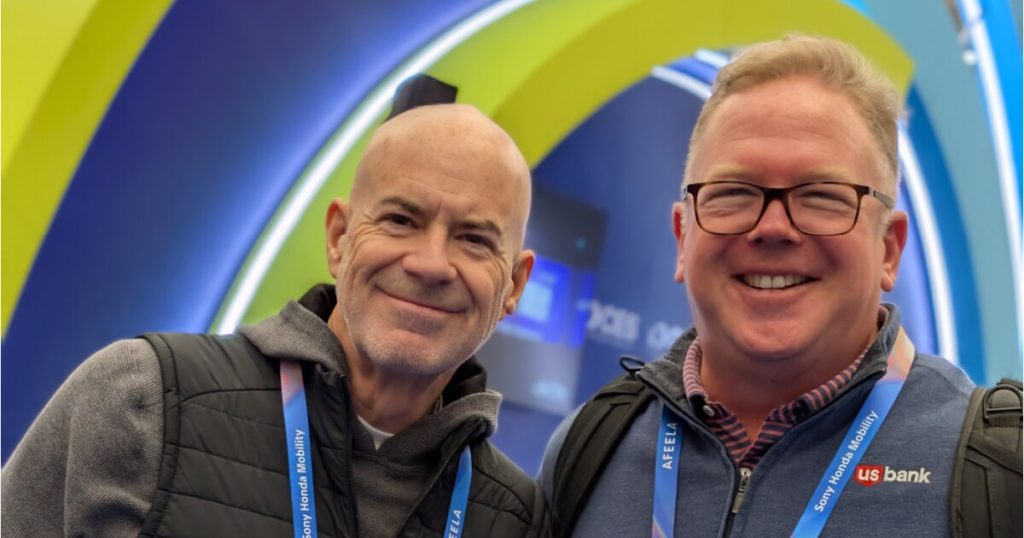
Every year, Don Relyea and Todder Moning go to the Consumer Electronics Show to see what new tech might be relevant to U.S. Bank, where Relyea is chief innovation officer and Moning is head of research and development, innovation.
Processing Content
This year, because the $686 billion-of-asset Minneapolis bank’s innovation team recently launched two business units — an AI Center of Excellence and a Blockchain Center of Excellence — Relyea was thinking about what should be the next areas of focus for the group.
“I’m looking at all these trends to try and figure out what’s the next big thing we’re going to gear up to launch in the next couple of years,” Relyea said. “We came back with a ton of new ideas, and I don’t know yet what’s going to play out as a new revenue center or new product suite.”
Relyea said that some ideas they came back with involve credit cards, payments and improving customer experience, as well as about a dozen potential partnerships in fintech, payments, wealth and other areas, though he wouldn’t share specifics.
Moning always goes to the show with an eye toward identifying how things are changing.
“We’re looking for the latest,” he said. “And that’s always a great show for that.”
CES, which is held in Las Vegas, had 148,000 attendees and 4,100 exhibitors this year.
Augmented and virtual reality devices like smart glasses, which were showcased at the conference, got Moning and Relyea thinking.
“Could I look at my portfolio in a more 3-D data visualization rather than reading?” Relyea said. “Are there ways to have data-driven conversations with these devices that could be more useful and interactive? We’re seeing some of those glasses get to the point where we might be able to explore that.”
Moning and Relyea also saw potential in agetech products.
One was a smart mirror that scans a person’s face for 30 seconds and provides dozens of biomarkers on heart, brain, emotional and cardiac health.
“It would give you an indication of roughly what age you might live to,” Moning said. Another had the user make a happy face, a sad face, a surprised face and an angry face to again, provide health markers relative to brain age.
Health care is adjacent to financial services, Moning pointed out.
“If you can improve your health and wellness, you’re going to have a longer life and have better outcomes, but you need the data to be able to do that, and obviously that has a lot of implications for money,” he said. “Money can change your biology, if you’re stressed all the time or anxious or worried or fighting with your spouse or partner about money. It makes us wonder, how can we more directly help people understand their financial health so that they can have better healthcare outcomes?”
Another hook for financial services is that people often worry about running out of money in retirement. “Knowing your longevity within a closer range is really helpful for financial planning,” Moning said.
And many of the new gadgets, such as a device that analyzes the user’s blood and provides more than 50 biomarkers, come with subscriptions. Tracking all those subscriptions is an opportunity, he said. (In October, U.S. Bank debuted a subscription management tool for credit card holders that lets them view and change subscriptions in the bank’s app and online banking.)
Most gadgets on display, such as rings and pens, had AI embedded that could potentially interact with agentic commerce and agentic finance.
“Both in the corporate world and in the consumer world, expectations for automation and ‘do it for me,’ as opposed to me filling out a form or typing in all of my own PowerPoint — that bar is going to get raised a lot over the next couple of years,” Relyea said. U.S. Bank is building agentic, automated services into apps and online banking in its AI Center of Excellence and working with partners like Mastercard on agentic commerce.