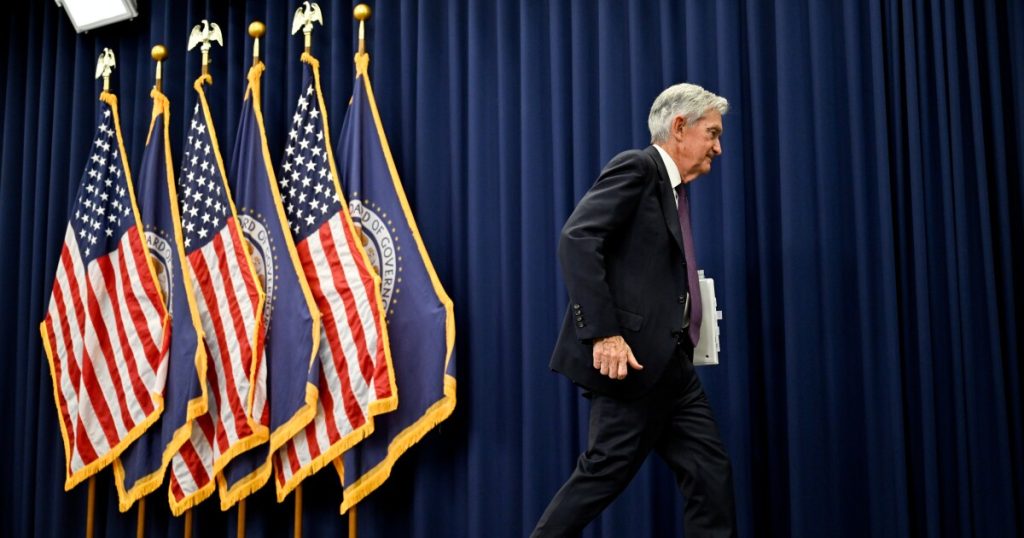
- Key insight: Federal Reserve Chair Jerome Powell said that he would remain at the Fed board after his term as chair expires next month in order to ensure that the central bank can continue to conduct monetary policy independently.
- Expert quote: “I worry that these attacks are battering the institution and putting at risk the thing that really matters to the public, which is the ability to conduct monetary policy without taking into consideration political factors.” — Federal Reserve Chair Jerome Powell
- Forward look: Powell will now be one of only two former Fed chairs to remain on the board, the other being Marriner Eccles, who remained on the Fed board after his term as chair expired in 1948. Powell said he would depart the Fed when he “think[s] it is appropriate to do so.”
WASHINGTON — Federal Reserve Chair Jerome Powell dealt a blow to the White House’s efforts to obtain a voting majority on the board of governors Wednesday, announcing that he would remain on the Fed board after his term expires next month.
Processing Content
Speaking at a press conference following the Federal Open Market Committee’s regular meeting Wednesday, Powell said he appreciated the Justice Department’s decision to drop its investigation into him, and was encouraged by assurances made by DOJ officials that it would not be restarted except if the Fed’s Office of the Inspector General issued a criminal referral in the matter. But he said his decision to remain is guided by what he believes is in the best interest of the Fed as an institution and the country as a whole.
“I’ve said that I will not leave the board until this investigation is well and truly over, with transparency and finality, and I stand by that,” Powell said. “After my term as chair ends on May 15, I will continue to serve as a governor for a period of time to be determined. I plan to keep a low profile as a governor. There is only ever one chair of the Federal Reserve Board. When Kevin Warsh is confirmed and sworn in, he will be that chair. Once sworn in as board chair, his new colleagues will elect him to chair the FOMC as well.”
Powell went on to say that his concerns about the Trump administration’s ongoing legal efforts against the Fed continue to be salient, and his decision to remain on the board is not a response to the president’s criticisms of him or the Fed’s monetary policy choices. Rather, he said, it is meant to bolster the central bank at a time of “unprecedented” attacks against the Fed’s independence.
“I worry that these attacks are battering the institution and putting at risk the thing that really matters to the public, which is the ability to conduct monetary policy without taking into consideration political factors,” Powell said. “It is so important for the economy, for the people that we serve, that they can depend, over time, on a central bank that operates that way: free of political influence.”
Powell added that he would leave the Fed board “when I think it is appropriate to do so.”
The Federal Reserve and Powell personally have been targets of President Donald Trump’s ire almost since Trump
Powell will be only the second Fed chair to remain on the board after his term as chair expired. The other former chair to do so, Marriner Eccles, remained on the board after his chairmanship expired because of an ongoing dispute between the Fed and the Treasury Department about which entity had the power to set monetary policy. Eccles ultimately left the board in 1951 with the signing of the
When asked whether his decision to remain on the Fed board could be interpreted as a political move — remaining on the board would deprive Trump of another pick to sit on the board of governors — Powell said his actions were entirely an outgrowth of choices the White House has made to pressure the central bank and erode its independence.
“I don’t see that at all. I’m literally staying because of the actions that have been taken,” Powell said. “I long planned to be retiring, and the things that have happened, really, in the last three months, have left me no choice but to stay until I see them through — at least that long.”
The FOMC press conference was also notable because there were four dissents from the majority statement, which kept interest rates steady at between 3.5% and 3.75% for the third straight meeting. The meeting marks the first time since 1992 that four FOMC members have dissented from a majority statement. One of those dissents, from Fed Gov. Stephen Miran, called for a 25 basis point cut. Miran has
The other three — from Federal Reserve Bank of Cleveland President Beth Hammack, Federal Reserve Bank of Minneapolis President Neel Kashkari and Federal Reserve Bank of Dallas President Lorie Logan — questioned not the decision to keep rates steady but the inclusion of a reference to “the extent and timing of additional adjustment,” which those members said amounted to an “easing bias” that would be an imprudent signal to send to the market at a time of
Powell said those discussions about forward guidance are healthy and appropriate, but said the dissents should not be viewed as a sign of heightened or unproductive division on the FOMC.
“The three dissenters — and others who were nonvoters and preferred it — they all supported the rate decision,” Powell said. “People are not saying, ‘We need to hike now.’ It’s more of a question of, ‘Don’t we feel that we should be neutral?'”
Powell also praised the press in his FOMC statement, saying that “careful reporting” is a public benefit the value of which he appreciates. He added that during the onset of the pandemic, it was beneficial for the Fed to be able to answer the public’s questions about their monetary policy actions through the media.
“During the pandemic we were moving a lot at every meeting — sometimes between meetings — and without a press conference, I think it would have been quite challenging,” he said. “It’s become an industry norm. That’s the standard. I don’t know whether that has to remain that way.”
Powell’s comments come after Kevin Warsh, Trump’s pick to succeed him as Fed chair, said during his
“Right now, press conferences are held periodically,” Warsh said during his confirmation hearing. “If you ask me my true personal opinion, right now, Fed chairs and other central bankers around the FOMC, they speak quite frequently. There is no lack of transparency. But I would say this, I think truth-seeking is more important than repetition.”
Fed press conferences are a relatively recent phenomenon, the
“I won’t see you next time,” Powell quipped.
Maria Volkova contributed to this report.